Thursday, 20 December 2012

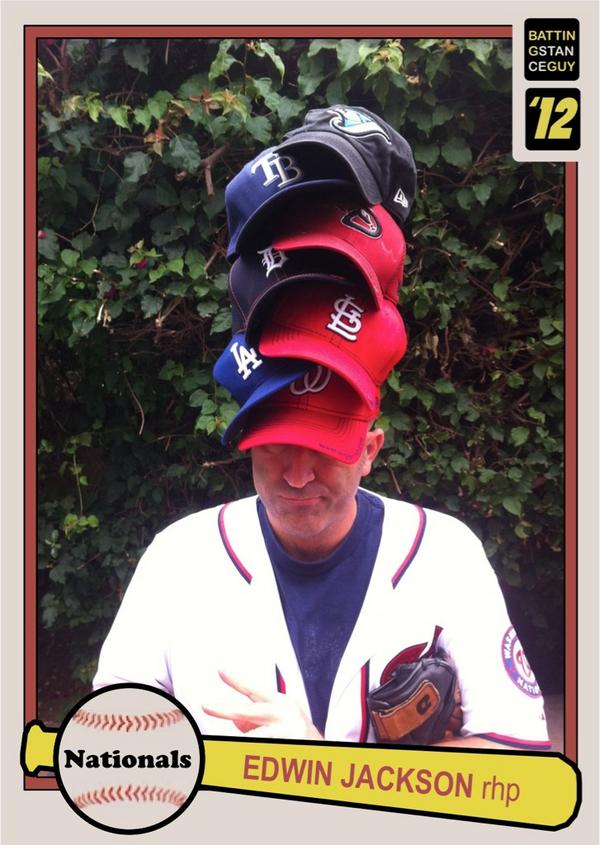
"Up in the Air," Professional Baseball Edition


Embedded image permalink
Don't Know if George Clooney is
"Attached to the Project" as Yet

ESPN is reporting that journeyman pitcher Edwin Jackson has signed to pitch for the Chicago Cubs in 2012, after agreeing to a four year, $52 million deal. The move means that Jackson will be pitching for his eighth team in 10 years (and ninth, if you count his fifteen minutes on the Toronto roster).

That's a lot of airline miles.  Rick Nelson was less of a travelling man.

A couple of thoughts.

  • This generation may have found its own Mike Morgan, who played for a baker's dozen in his 20 year career, one of them being the Cubs
  • Will Jackson, with his four year deal, know what to do if he's not packing up and moving in November?
  • Edwin will be wearing a new uniform this spring for the fifth straight year.  THAT is impressive.  It's not as impressive as Dave Kingman playing for four teams in one season, or Joel Youngblood, playing  for two teams on the same day, but not bad.
  • I'm in the wrong racket.  In a single season, Jackson will make $13 million.  "Mediocre" is one of many words to describe his performance to get that payday. Lifetime, the guy is 70-71, with a 4.40 ERA.  Last year, pitching for a playoff team (Washington), he went 10-11.  C'est la vie.
  • I feel better that the Blue Jays shelled out $25 million for R.A. Dickey, a mere $12.5 per season.  Dickey won the Cy Young last year...


Say Wha? Nero Continues to Fiddle in Sacramento

California Treasurer Bill Lockyer Calls the Tunes

Just checking in to see the latest foolishness on the soi-disant "fiscal cliff" (TM) at Yahoo Finance, and I came across this little tid-bit.

Bill Lockyer, the current treasurer for the economically sinking state of California has "warned" various i-banks (Credit Suisse, Black Rock) that he would use his power to push the state's two largest public pension funds to "get out of guns," whatever that means.

Now, aside from the irony of a thoroughly bankrupt state employing a political goon like Lockyer to be the "treasurer" of a vault full of IOUs, I marvel at the apparent lack of awareness of a man whose job ostensibly overseeing CALPERS is to provide for the old age pensions of public employees, not to moralize about investment in legal corporations selling legal products.

If I were a school teacher, housing inspector, or clock puncher at Cal Trans, I would be less than thrilled that this guy is not thinking of my best interest when making investment choices.  I might even think of filing an action of fiduciary conflict.


Wednesday, 19 December 2012

The New Math (Reloaded)


"It's the new math.  New-ew-ew math.
 It won't do you a bit of good to re-view math.

 It's so simple; so very simple.
 That only a child can do it."

                      -- Tom Lehrer


Ah; the Christmas season.  The tree is trimmed.  The presents are mostly wrapped.  Wassailing is mostly done.  The new year is around the corner.  And the fiscal cliff approaches.

Well; that's not -all- true.  Who goes wassailing anymore?  And what is it, anyways?
But oh, the fiscal cliff; truly, the most wonderful time of the year.

I read today on the financial blogs that the House speaker John Boehner has not presented a "Plan B" to the president, including tax rises on families making $1 million and more.  Taxes on "the rich" will go up, apparently.  Hell, the plan was one floated by Nancy Pelosi last year.

So of course, we've got a deal, right?  The president immediately accepted, and the two then really did dash out to go wassailing.

Well, not quite.

The recalcitrant president has indicated that he would veto such a plan, despite talking ad nauseum for the past 18 months about the need to raise taxes on "millionaires and billionaires."  

Now that such a tax is in front of him, he flatly turns it down?

Because, apparently, there are not enough (or any?) 'cuts' in Boehner's plan.

You read that right.  A DEMOCRATIC president refuses a REPUBLICAN proposal to raise taxes on millionaires because it doesn't have enough CUTS to spending.

We're really through the looking glass, aren't we?

But as nutty as all of that is, the best part is that White House communications director Dan Pfeiffer opined that the two sides were "only a few hundred billion apart," with hope a deal could be reached.

So, in Washington DC, where a millionaire is not a millionaire, now a few hundred billion dollars is now a trivial difference.

We're doomed.


Monday, 17 December 2012

Madness, by Any Other Name


Gun Control: When Is Enough Enough?

A weekend has now passed between us and the horrific shooting in Newtown, CT.  The images of crying, shaken young children will not soon be forgotten.  And the thought of little five and six year old, lifeless children with unopened Christmas presents and named stockings forever awaiting a return that will not come, spending the weekend pending crime scene investigations to be completed is too terrible a thought to consider.

Predictably, the discussion has turned to what to do about this.

I would self-identify as a pretty far-to-the-right conservative.  Not a libertarian, per se, but in that general ZIP code.  And I have to say, listening to my political fellow-travellers talking about this, and in particular, the possibility that we may finally, FINALLY get some sort of sane gun control policy is a journey into madness.

For a start, former Arkansas governor Mike Huckabee opened the bidding with the comment that this is all due to the fact that Americans have "systematically removed God from our schools."

Really?

And National Review have multiple articles arguing that gun control is not a part of the solution.  Indeed, that having gun-free zones actually contributes to the problem.  You see, their logic goes, it would all have been OK if the principal, or the teachers, or maybe a parent dropping of her kids at the kindergarten had been carrying a gun.

It's madness.

For a start, the idea that putting in place limits to the type and/or number of firearms is equivalent to wanting to "ban guns" is not just madness; it's stupidity.  Someone suggested to me that there is "no difference" between ownership of a single-shot hunting rifle, a revolver, a Bushmaster, or a trebuchet (??!!??).

Really?

I can see a BIG difference.  A numerical difference.  As in, the number of bodies that will result.

Also, what sort of "hunting" does one propose to do with a military-grade weapon?

At a more reasonable argument from NRO, the suggestion is made that we as Americans have an inalienable right to armaments, and that the Constitution (and amendments) are there not to spell out what our rights are, but what the limitations on our government are.  And the Second Amendment clearly states that our right to keep and bear arms shall not be abridged.  Thus, their argument goes, God himself has granted people the right to arm themselves with whatever weapon they choose.

Madness.

The Second Amendment states that we have a God given right (or, natural right, if you prefer) to keep and bear arms to defend ourselves and our liberties.  That is a FAR cry from arguing that God in His wisdom has decided that we all may arm ourselves to whatever level we want, with absolutely no restriction.

How many of such "conservatives" would argue we have the right to bazookas, or artillery pieces, or perhaps a nuclear-tipped warhead?

And while we are at it, if God has given us the right to pack whatever weaponry we wish, then how does the government have the power to remove such a "right" from mentally ill people?  Or criminals?

I've actually heard some people claim that we "need" these weapons in case our government gets too tyrannical, so that we may rise up against it.

Madness.

Who in his right mind thinks that a disorganised band of delusional buffoons are going to be able to over-throw the government, with its tanks, planes, helicopters, artillery pieces?  "Red Dawn" was a movie, folks.  And a not-well-made one.

The point is, sensible people understand that we need to balance the "rights" (and more accurately, the desires) of one individual against the rights of others.

The Republicans are just dead wrong on this.  Yes, we need to take steps to reduce the toxicity of the sewage culture - with its phony machismo, out-sized sense of "respect" that is frankly narcissistic, and plain glorification of violence.  Yes, we need parents to be parents.  We need to make sure that mentally ill people have the resources and equally, avail themselves of those resources.

But I'm sorry.  Pretending that bromides about how "guns don't kill people, people kill people," or clinging to fantasies that these yahoos are somehow keeping an otherwise tyrannical government in check is killing people.

The Democrats are right on this one.

We NEED to look at serious gun control.

Now.


Friday, 14 December 2012

And the Band Plays On


Last night, I got cross at my seven year old son.  It's not an infrequent occurrence, usually a pretty minor crime like ignoring (repeated) requests to put away a toy, or focus on his math homework.  Last night, it was an all-too-typical infraction: during dinner, he just would not sit in his chair properly, and thus spilled some of his cake on the table.  I angrily asked him, "what is wrong with you?  Why can't you sit in a chair properly, like the rest of the human race."

Hmmmm....

Today, I am confronted with a terrible story; truly, an awful, horrible and tragic event.  Not all of the details are yet known, but as of right now, it appears that a 20 year old man has gone into an elementary school in Newtown, CT, and killed 27 people.  18 of them are children, ages between 5 and 10.  No "reason" is given, though comments are that the 'gunman' had some connection to the school, and it is presumed was upset about something there.

Daily, our news contains typically awful stories of mayhem and violence.  A few days ago, another 'gunman' went into a shopping mall in suburban Oregon and opened fire.  Gun (and other) violence are all too familiar.

I seldom feel affected by the news - usually, I read the story, chalk it up to the crude, brutish nature of the human race, and move on.

But there is something about this story that I find affects me unlike other stories have.

I don't say (or write) this very often, but the emerging narrative from Newtown, CT has actually, literally, left me feeling stunned and shaken.  There is an overwhelming, and awful, feeling of anger and sadness that I'm struggling to control.

I really don't know exactly what to say, or think.  Is it because I have a small child of about the same age?  The time of year (Christmas holidays)?  Maybe the oncoming cold that has left me a bit off to begin with, or the Tylenol Multi-Symptom cold remedy?

It's all too easy to try to just get mad and talk about how the killer is crazy, or that guns are too easy to get, or that our national culture is a sewer of nihilism and violence.

All of these are true, no doubt.

But still.  27 people have been murdered.  18 of them are less than 10 years of age.  Why?

My son probably will tonight, again, fail to sit properly in his chair at the table.  But he also will be able to sleep in his own warm, safe bed.


Tuesday, 6 November 2012

Thoughts on Election Day, 2012


The day has finally arrived.  A day of reckoning for a president who has, at best, a mixed record.  A day of reckoning for a candidate who, at best, has provided a mixed argument for why he could do better.

One is going to prevail; I suspect it is going to be President Obama, though stranger things have happened.  As a mathematician, I tend to be swayed by data and numbers, and find Nate Silver's 538 Blog to be pretty convincing.

Four years ago, I voted for Barack Obama.  Mainly because I did not like the wars in Iraq and Afghanistan, but also because he seemed to be a different sort of candidate.  One who said the right things - offering optimism that things would be better if he were elected, not fear that things would be worse if he weren't.

My very first "blog" post here was a reaction to the the election; I read through it today.  In summary, my thoughts came down to this:


I agree with Barack Obama that there should not be a Blue or a Red America. To that end, I also reject that there are ethnic "winners" (and therefore, by necessity, ethnic "losers"). It's up to him, and not talking heads with little to recommend them beyond good hair (e.g., Anderson Cooper) to decide that America, and not splinter groups, have won. 
And I guess that is part of the change I am hoping for.


In part, because Mr Obama has failed to deliver on this change, I have voted for his opponent this year.  However, it is not my goal or desire to tell people at this point how to vote.  By now, most have heard the arguments, and have made up their minds.

I only would make the following suggestion.

Whether your candidate wins or whether he loses, we simply have to remember that our political opponents are not our enemies.  In the end, we are all in this together.

I disagree with the Democrats, largely.  But I do not believe that they are evil.  They are just wrong.

They don't want to wreck the country.  Their vision to making it better is just different from mine.

This has been a very nasty campaign in which both candidates and, more to the point, their proxies have said and written terrible accusations about the other.  I guess that's the nature of winner-take-all-politics.

I reject the idea that Barack Obama is a secret communist who wants to destroy our capitalist system, subjugate us to sinister, supra-national powers, or hates success, however you want to define it.

I reject the idea that Mitt Romney is a heartless villain who wants to starve poor people, toss the elderly and weak into a lake, or hates women.

Your political opponents are largely your neighbours, your colleagues, and dare I say it, your friends.  And thus, when we wake up tomorrow and your "team" won or your "team" lost, let's try to remember that fact.

Thursday, 1 November 2012

Reflections on Sandy


Let's Give Three Cheers....

Today, for the first time in nearly a week, the sun is shining here in central New Jersey.

"Sandy" is gone; the buzz of saws cutting felled trees surrounds.  Everywhere, water is receding, things are drying, and we're slowly returning to normal.

Our family was blessed - aside from a couple of decorative trees in our yard that succumbed, and the nuisance of power loss for a day or so - we came through relatively unscathed.  No one hurt.  No property destroyed.  Not a drop of water in the basement to be seen.

Others were not so fortunate.

It's of course an election year, so our country has spent the better part of a year arguing about one per cent, 47 per cent, big government, responsibility.  

Personally, I've been a big critic of the Democratic party model - high taxes; support of entrenched public unions; big government.  I remain firm that the model offered by the president and his party is the wrong one, fundamentally.

But I'm not, and never have been, in the camp that says that the "private sector" does everything better than the public one.  I like to consider myself a pragmatist, sceptical about the centralisation of power, but open to arguments and empirical evidence.

The hurricane that has destroyed large parts of my state I think illustrates pretty well that there is a legitimate role for our federal government, and that there are just some things that are too big, too complex, to be left to the states or the private sector.

Sometimes, "big government" may be the right answer.

I also think it's worth taking a second to acknowledge and say "thank you" for public and private sector workers who set aside their own interests and families to take care of the rest of us.  

All Monday evening, as the storm hammered our town, I could see out my window flashing red and blue lights - police officers and firemen (in our town, a volunteer fire department made of residents from various walks of life).  

These people all have families.  They all have homes.  They were out in harm's way, not at home with their loved ones to steady the home front; out there to help keep us safe.  Police, especially, take a lot of criticism, and seldom get the thanks they deserve for a difficult, necessary job.  When you're in real trouble, and you ring 9-11, you don't get Kim Kardashian or Kanye West or any other intellectual flat-liner to come.  

You get a man in a blue uniform whose function in life is to serve and protect - not to amuse.

Police are government workers.

Tuesday morning, crews were out working in the continuing wind and rain to restore power and other infrastructure.  They were in the elements, not at home fixing their own homes or pumping water out of their own basements.  They were not with their families to calm frightened children.

These folks work for the "evil" power companies who make our modern lives and comforts possible.

Today is the first of November, and my property taxes are due.  These are assuredly *not* low, and I would love to have more of our money remain in our bank and not in government coffers.  But we pay taxes for a reason. 

We will rebuild.  We will recover.  

This is because we look out for each other, sure.  We all stand together.  But it's also due to the dedication of people we largely don't think about most days, or worse, complain about on others.

Thanks, guys.  We'll leave the light on tonight for you.


Friday, 26 October 2012

The Land of Chocolate (and High Taxes)


Homer Simpson
Homer Would Probably Vote YES on Prop 30


The election is now just over a week away, and still not quite sure what the 6th of November will hold.  I suspect that President Obama will win, though given how poorly he has performed recently - and just how how shrill and desperate his supporters have become - I am less confident of that than I was a month ago.

But as the French say, plus ca change, plus c'est la meme chose.  Put simply, some things apparently never change.

In my old home state of California, awash in a sea of red ink of volume only slightly less than the San Francisco Bay, apparently, Governor Jerry Brown has put on the ballot Proposition 30, which would place sur-taxes on "very high" incomes to help to balance the state's shaky books.

(As an aside, all the sturm und drang about Mitt Romney's infelicitous "binders full of women" remark I suspect should be placed against the Democrats' ledgers full of nothing.)

Governor Brown's proposal would, for example, raise taxes on people earning 500,000 per year from 9.3 to  12.3 per cent.  The Proposition is leading in the polls, and likely will pass, though support is sliding.

Mr Brown today offered in an interview that the rich have a moral obligation to pay more, citing Biblical scripture.  Setting aside Governor Brown's very shaky math - he defended the tax raise pointing out that a 3 per cent rise in tax is modest; in fact, a rise from 9.3 to 12.3 per cent is more than a 30 per cent increase - but what's a little fun with numbers among friends.

The larger issue is do the rich have a moral obligation to pay more in taxes?  And, more to the point, how much more?  We've all seen the data, and heard the notorious comments by Governor Romney about the 47%.  The richest 1 per cent pays about half of all income taxes.  I suspect that, in California, home to among the most progressive income tax regimes in the country, that figure is probably not far off.

I am not a fan of the flat tax for various reasons, and I generally accept the socialist argument that those with more should pay somewhat more.  But when do we ask the question, does the government have a moral obligation to spend its revenues wisely?  To be a better steward of its resources than it is?

Senator Tom Coburn (R-OK) recently released his book on government waste, and suffice it to say, I wonder how ethical it is for the government to take in tax money and spend it on sports arenas or the PGA Hall of Fame.  And do we really need to be promote watermelon consumption or to create robotic squirrels?  I've seen all of the "Terminator" movies, and am suspicious that that last effort is going to end well.

But good Old Governor Moonbeam - who once aspired to the priesthood - adheres to at least a segment of the faith.  Right to the bitter end, apparently.


Tuesday, 9 October 2012

Tune in Tomorrow, When We're Gonna Do *FRACTIONS*


Came across an interesting article yesterday in The Economist.  The authors were commenting on a recent study by economists at the University of Miami that discovered another reason why mathematics are important.

It turns out, the 'average' American's inability to grasp concepts around fractions and proportions, added to the lure of "more," yields poor choices, at least when it comes to the allocation of economic resources (i.e., our money).

The study of 600 shoppers asked for opinions on the best "bargain" when confronted with various options.

Overwhelmingly, when given the choice of the same amount of product for less vs. more product for the same price, the shoppers opted for more, even when the better bargain was the latter.

As an example, shoppers were given the choice of product A, either at a 33% discount, or 33% additional product at no additional cost.  The choice overwhelmingly was for "more stuff for free," with shoppers indicating that the two 'bargains' offer the same value.

Well, a quick look at the maths makes it clear that the better choice - economically speaking at least - is to opt for the discount.  Quickly think of a 10 ounce bottle of shampoo, for $1.  If you get the same shampoo at a 33% reduction, you will pay 67 cents for 10 ounces.  That's 6.7 cents per ounce.

On the other hand, if you opt for "more stuff," you get 13.3 ounces for one dollar, or 7.5 cents per ounce.  As an aside, for the two to be equivalent, the additional "free" product would have to be 50% more.

In another experiment, shoppers were asked to compare two scenarios, one where a product was discounted 40%, and another, where a product was discounted 25%, and then given a "super" additional discount of 20% on top.

Again, overwhelmingly, the shoppers thought that option B was superior.  The classic, grade eight algebra fallacy that 25% plus 20% must be 45%.

In this case, the two scenarios are equal.

Think of the same bottle of shampoo, offered at $1.  A single, 40 per cent discount takes the price to 60 cents.  Under the second scenario, the initial reduction takes the price to 75 cents, with an additional 20 per cent reduction taking the price to, once again, 60 cents.

We tend to 'fall' for spurious "buy one, get one free," or "additional discount taken at register" offers, and ignore what our high school maths teachers taught us about fractions and how to multiply and add them.

When in doubt, one can of course ignore the math test, and instead just rely on reading - at grocery stores, virtually all products listed will print the unit price on a small tag on the shelf.  When in doubt, just read.


Monday, 8 October 2012

....and It Falls In! But Wait!


I Got It!  No, You Take It!

The controversy and debate continue to rage.  A crucial moment and one of the contestants just stands there and lets the ball fall in.  And one side of the argument screams that those chosen to moderate the contest made the wrong call. Passions are inflamed.  The argument goes on and on about just what the proper role for judgment by the referees of the contest ought to be - when should they let the two sides just go, and when should they intervene?

Of course, I'm talking about the Friday National League "wild card" playoff game between Atlanta and St. Louis, a topic that is far more interesting than just how 'wrong' Clint Eastwood's now almost prescient observation about empty chairs was...

The situation for those not following professional baseball, is as follows.

The Atlanta Braves and St. Louis Cardinals faced off Friday evening in a winner-take-all contest in Atlanta.  The Braves, over the first handful of innings had kicked and thrown the ball around to the point that they trailed the Cardinals 6-3 late in the game.

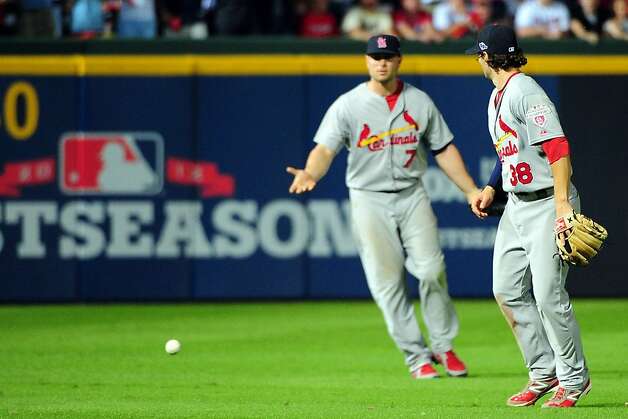
Entering the bottom of the eighth inning, a little life.  A walk.  A fielder's choice, and a single placed runners at first and second with only one out.  The Braves had been pretty ineffective until then with runners on the bases, and that futility appeared to continue when shortstop Andrelton Simmons popped a lazy fly ball into shallow left field, perhaps 75 feet over the head of St. Louis SS Pete Kozma, but in front of left fielder Matt Holliday.

Now, this is a play that 99 out of 100 times, one or the other will "call for" the ball and make an easy catch.

It's that one of 100 - where, because of poor communication, or the noise of the stadium, where one or both of the players will simply stop, and the ball will fall, unmolested, to the turf for a gift single.  Which of course is exactly what happened, as Kozma, who at first signalled for the catch and then at the last second, peeled off.  Holliday had stopped running in, and the ball landed to the joy of the Atlanta fans.

The celebration was short-lived, as left field umpire Sam Holbrook called Simmons 'out,' despite the non-catch.

The reason for the call: Holbrook invoked the rule that is the subject of discussion in the first days of every little league practice in the US, and I suspect, many other countries: The Infield Fly Rule.

Without getting into too many details, the rule basically was put into place decades ago to prevent the defenders intentionally allowing an easy pop-up on the infield to fall, then quickly picking the ball up for an easy double play.  The situation requires:


  1. There are runners on first or second, or first second, and third (thus setting up TWO force outs on the bases)
  2. There are zero or one outs (thus setting the possibility of getting TWO or THREE outs on the play)
  3. That the ball is one that one of the infielders can catch WITH ROUTINE effort (as judged by one of the umpiring crew)
  4. That ultimately, the ball must land in FAIR territory.

There are other details, of course, but the point is, a fielder cannot gain advantage by intentionally not making a play through chicanery.

What is in dispute in all of the above is item three - just how "routine" the ball was (and it was, to be fair, an easy catch), and did the umpire make the right judgment call?

Much of the debate I've heard has focused on things such as the nullity of the call because a base umpire did not make it (irrelevant - there is nothing in the rules stipulating which umpire must make the call - and there are only outfield umpires in the playoffs and All-Star Game), to the fact that the left fielder called for the ball (which is a false argument, because the rule specifically says that an infielder need not make the call, and does, in fact, state that the rule is in effect even if an outfielder ultimately makes the catch), to the fact that Holbrook waited until the point that the ball was past its apogee and was near the ground (which strikes me as a reasonable point).

As I see it, the call is plainly the wrong one because of three factors.

First, looking at the intent of the rule - does anyone believe that Holliday and Kozma meant to let the ball fall?  Was there an attempt to gain a dubious advantage by allowing it to land without being caught?  I don't think so.

Second, was there a real expectation, or even a chance, that in not catching the ball, a double play was possible?  Not a chance.  At best, after the ball landed, the Cardinals might have been able to force Dan Uggla out at third.  In fact, they did not even succeed at that.

Third, and most important - as I see it, the empirical measure of whether a call is right or wrong is this: Suppose the call had gone the other way.  That the infield fly rule were not invoked.  Would the other team have argued the call so angrily?  Would they have argued it at all?

I suggest that, had the infield fly rule not been called, the St. Louis Cardinals would not even have complained about it, and indeed, their players and fans would have focused their anger on why two professional players failed to catch a routine popout in shallow left field.

All the other comments I'm hearing are just noise.  The infield fly rule is not complicated.  It's not difficult to understand.  One need not be a former major leaguer to grasp it.  It's a simple rule, and the problem here is entirely about whether a human being used the right situational judgment around whether to invoke it or not.

The bottom line is this: Pete Kozma should have just caught the ball.

And the Atlanta Braves should not have made three errors.