Tuesday, 9 April 2013

The New Stepinfetchits


                Is You Is, Or Is You Ain't My Baby, with a Modern Twist, Courtesy

                    of Current Manufactured Flavour of the Month Lena Dunham

It may seem an odd comparison to put the now painfully racist image of actor Lincoln Perry - better known as the self-described "Laziest Man in the World" Stepin Fetchit - next to the currently uber-hip actress Lena Dunham, writer and star from the uber-hyped HBO show "Girls.  But a recent column by writer and classics professor Victor Davis Hanson more or less does just that.

Perry made an enormous amount of money 80 years ago - allegedly becoming the first black entertainer to make a million dollars - playing to white stereotypes.  He got rich at, arguably, the expense of other black people of whom ugly stereotypes were re-enforced on the screen.

Well, Dunham and other hipsters have similarly traded on their fame to push forward the meme that the modern, re-distributionist Democratic party is the party of the young, when in fact, the policies advocated by President Obama, Senator Harry Ried, and Congresswoman Nancy Pelosi - the latter two decidedly not young or particularly 'hip' - are retrograde to the real interests of young people.

It's true that the Republican Party - called "the Stupid Party" by Gov Bobby Jindal (R-LA), and not without accuracy - take social stands that have frankly been rejected by the young.  On virtually all social issues:  same-sex marriage, gun control, drug decriminalisation, the environment, the Republicans are at odds with young voters.

But Hanson rightly points out that, while these issues are not - and should not - be seen as trivial or unimportant, it's reasonable to ask just how centrally they ought to be placed by young people who are simultaneously being asked to accept a large and growing burden of debt caused largely by IOUs paid to wealthier, older voters and poorer job prospects largely caused by and increasingly difficult regulatory climate and immigration policies that promote the ludicrous idea that what our post-industrial, 21st century, knowledge-based economy needs to be competitive is a continuous flow of poor, uneducated high school dropouts.
(T)he new liberalism in all its economic manifestations is reactionary and anti-youth to the core. The administration seems aware of the potential paradoxes in this reverse “What’s the matter with Kansas?” syndrome of young people voting against their economic interests. Thus follows the constant courting of the hip and cool BeyoncĂ©, Jay-Z, Lena Dunham, Occupy Wall Streeters, and others who blend pop culture, sex, youth, energy, and fad — almost anything to avoid the truth that today’s teenagers are starting out each owing a lifetime share of the national debt amounting to more than three-quarters of a million dollars. Those who ran up the debt enjoyed the borrowing, but won’t be around to pay back their proverbial fair share.
Dunham et al, from their comfortable sinecures are lending their cache to politicians who are essentially mortgaging the future of the very people they portray on stage and screen, for amounts of money that would make the collective heads of "the 99 per cent" explode.

My question is, at some point, these self-deluded consumers of political bunkum will wake up and smell the over-priced latte.  Won't they?

Monday, 8 April 2013

Get Me to the Church on Time


Lisa the Iconoclast2
 Not Sure if Miss Hoover Attended Princeton...

Lisa, this is nothing but dead white male bashing from a PC thug.  It's women like you who keep the rest of us from landing a husband

Came across this op-ed in the NY Times this weekend by the redoubtable Ross Douthat.  In his piece, Douthat points his analysing eye at a recent kerfuffle at Princeton University.  One of its alumnae wrote a letter to the Daily Princetonian, in which she offers the following advice:

Forget about having it all, or not having it all, leaning in or leaning out — here’s what you really need to know that nobody is telling you.
For years (decades, really) we have been bombarded with advice on professional advancement, breaking through that glass ceiling and achieving work-life balance. We can figure that out — we are Princeton women. If anyone can overcome professional obstacles, it will be our brilliant, resourceful, very well-educated selves.
The letter generated the usual intramural food fight about the patriarchy, proper "gender" (sic) roles, sexism, and the like.  We can (and probably will) argue about what women "want" until the end of time.  I thought that the Mel Gibson movie might be dispositive, but then Mel sort of imploded in a froth, so...

But Douthat actually raises the more interesting and truthful discussion.

That women now have more choices than they did 50 (or even 25) years ago is undeniable.  Few - including the writer of the letter, a Susan Patton - would argue that a woman needs to be married to lead a fulfilling life, which is the straw man (straw woman?) self-identified feminists raise.  But few people want to spend their lives single, even "strong women."

Take a quick survey of your closest friends and colleagues - how many of them, all else being equal, would choose to remain single?  Any hands up?

In my admittedly selective sample space, I know of very, very few woman who want to be with a partner who is less educated than they are.  Lee Kuan Yew, the founding father of Singapore, once commented something to the effect that no Chinese man wants to marry a woman with more education than he has.

In the US, it seems that the converse is true - few women are willing to marry a man of lower social stature than she has.

As another quick thought exercise - think of the entire set of female friends and colleagues who surround you.  How many of them married "down" - to a man with less education, less social stature, and frankly, less financial earning potential?  Any hands still up?

What that means to the undergrads at Princeton (and Harvard, Yale, Stanford, etc.) is both obvious and determined.  These people see themselves, right or wrong, as a sort of elite, master class.  Thus, by necessity, for a Princeton alumna to marry someone of her own social class rules out the overwhelming majority of potential mates.  And thus, Patton's statement - that if a Princeton alumna wants to get married, her single best set of prospects surrounds her during her time as an undergrad.  This fact should be spectacularly uncontroversial to anyone who spends more than three seconds considering it.

Douthat raises this point, and then takes it further into an exposition on class and status in the US.  The replies on the comments page attacking him essentially prove the point that Patton was making.


Monday, 1 April 2013

Baseball Is Back (At Last)


Yep; today starts the month of April, and aside from the arrival of taxes, that means only one other thing.

Baseball is back.  (caveat: the first official game was actually last night, in March.  The Houston Astros began life in the American League after 51 seasons in the NL.  Even stranger, they won).

Some random thoughts.


  1. The Yankees have been crushed, 8-2, in their opener.  Sporting a starting nine that includes Jayson Nix, Vernon Wells, and Kevin Youkillis (with Lyle Overbay brought on as a PH to add even more spice), the Bronx Bombers could actually be in for a very long season.

  2. The Pittsburgh Pirates and Chicago Cubs have just wrapped up a quick 3-1 affair, won by the Cubs.  The game featured nine hits and 26 strikeouts.  Ouch.

  3. The New York Mets started their season in convincing fashion, with an 11-2 trouncing of the San Diego Padres.  Normally, I could take or leave the Mets, but this off-season, they were the other half of a perhaps pivotal trade with my team (the Toronto Blue Jays); the Jays sent top prospect Travis D'Arnaud to the Mets for 2012 Cy Young winner R.A. Dickey.  Dickey starts tomorrow in the SkyDome, and D'Arnaud did not play today, so the evaluation has to wait at least one more day.

    In the Met game, the Mets pounded out 13 hits, with eight of the nine starters each collecting at least one hit, including starting pitcher Jonathan Niese.   The only Met not to reach safely was Ike Davis, who not only went 0-5, but struck out four times.  A Golden Sombrero.

  4. The Giants and Dodgers continue their 137-year grudge match in LA.  The Dodgers feature a roster that truly spared no expense, adding Josh Beckett, Zack Greinke, Adrian Gonzalez, Hanley Ramirez, and Carl Crawford.  The LOWEST contract on that payroll is Greinke, a bargain at $14MM.  That's an awful lot of green to make up the Dodger Blue.

  5. The Blue Jays season, as mentioned above, starts tomorrow, much as it did in 2012 with the Cleveland Indians.  This year, the teams face off in Toronto instead of Cleveland.  The Jays are actually hopeful of competing this year for the playoffs, something they have not done in two decades. No; not that they haven't made the playoffs since then - though that, too, is true.  The Jays have not contended in any real sense in twenty years.  The "highlight," such as it were, was seven years ago, when the team went on a hot streak at the end of the year to nip Boston for second place in the AL East.  Even then, the team wound up 10 games out of first.
Should be fun.


Water Water Everywhere; Let's all Have a Drink


Read The Rhyme of the Ancient Mariner more years ago than I care to remember, but still remember the so-called money shot from the story.

I was thinking of it as I read an editorial in Yesterday's NY Times, penned by the economist Greg Mankiw.  Mankiw, a professor of economics at Harvard, was an adviser to President George W Bush.

Much has been written about our current state of financial affairs; the yawning deficits.  The crushing debt.  Sequestration.  The sustainability (or lack of) for Medicare and Social Security.  Pensions.

All told, it's more a current state of financial disrepair.

But Professor Mankiw raises an interesting point, and one I think many ordinary Americans do not grasp.

Fundamentally, the DEBT (the accumulated amount of money our government - we, in a sense - owe) is somewhat beside the point.  Plainly, with public debts in the multiples of trillions of dollars, the debt as it now stands, of course will never be repaid.  Even the deficits, in absolute terms (simply put, the difference between the amount of money collected by the government and the amount of money spent) are of secondary concern.

Mankiw makes the point reasonably well, but perhaps a bit opaquely.

In my day job, I am responsible for creating economic and epidemiological models to simulate patient pathways from health to sickness and back to health (or, mortality).  In my science, one invaluable tool is the stock-flow model.

From these models, we derive what are called the "incidence" and "prevalence" of disease (among other things).  Incidence is, essentially, the number of people who newly are afflicted with a given illness.  People who last year did NOT have lung cancer, for example, but who now do have lung cancer.  Its cousin, prevalence, is the total number of people who right now have the disease.  This is all the people who had lung cancer last year, and have not died, PLUS the people who are incident this year (very, very few people are "cured" of lung cancer, but of course, in a broader sense, people who are cured of a disease move out of the prevalent pool).

Within the prevalent population, there may be different stages of disease, but that lesson can be left to the side for another day.

If we think of a stock-flow model as a sort of bath tub then, the water POURING INTO the tub (new patients with a condition) represents the incident patients.  Patients in the tub represent the prevalence.  Some patients may be escaping the bottom of the tub (death; cure).  The tub may come to represent a certain equilibrium if the number flowing in (incidence) is roughly equal to those flowing out.

In terms of economics, I feel that these concepts translate naturally thusly.

The bathtub is our national economy.  The water IN the tub is our debt.  Water pouring into the tub each year then represents annual spending.  The bottom of the tub, from which water is escaping, represents revenues (taxes).

If water is pouring into the tub faster than it is escaping, then the level of water in the tub rises - our government is running deficits and the debt is increased.  If water is escaping out of the drain faster, then the government are running surpluses, and our debt is shrinking.

We reach catastrophe if the tub overflows - if we default.

Now, the argument that Mankiw and others rise is this:  If the tub EXPANDS, then the amount of water pouring in can increase safely.  That isn 't necessarily good or bad, of course.  But simply running deficits is not in and of itself dangerous.

The tub, then, can be thought of as national GDP.  When it is growing, then our capacity to take on debt grows.  On this, Mankiw (and the president) are correct, as Dick Cheney before them were.

The problem that Mankiw (and President Obama and VP Cheney) miss is that the presumption that our GDP will ALWAYS grow is flawed.  If the tub stops growing - or worse, shrinks to the size of the bathroom sink - then we have a big problem.

During the past decade, the tub has not kept pace with historic growth and worse, the tap is now wide open and no one is thinking to put a hand on the spigot, let alone reduce the flow.

Friday, 29 March 2013

California Dreaming


Came across a news item today from the old home state of California.  Sacramento is, as is well known, broke.  And looking for ways to raise some cash.  Folks on the Left Coast are nothing if not creative, and have conjured up what I think is a brilliant idea.

The legislature has passed a bill enjoining the DMV to considering issuing "Legacy Plates" to car enthusiasts.

About a year ago, I wrote this blog post about the evolution of California licence plate number schemes.  The state historically is home to some of the most iconic number plates (the gold on blue many Americans think of, the famous black plates, the old black on yellow scheme made famous by the THX-138 George Lucas cruiser in "American Graffiti") in America.

According to AB1658, signed into law by Governor Moonbeam in September of last year, the DMV is now collecting pre-orders for any of three classic styles:

Black on Yellow, 1956-62 
Yellow on Black, 1963-69
Gold on Blue, 1969-82


According to the law, if 7500 applications for any of the schemes are received, the DMV will begin issuing that scheme.

There are some issues with this plan; for example, the circa 1956 plate originally had the word "California" flush-left, and not in the middle, and the more classic Gold-Blue scheme was formatted as 123 ABC originally, moving to the now familiar 1ABC234 scheme around 1980, when the six character format was mathematically exhausted.  Still, at $50 a pop, this offers the enthusiast a chance to add a little additional style to his classic ride, and a chance for the state to get some additional revenue.

While not Jay Leno, I do appreciate automobilia, and am the proud owner of an antique MG T-series car.


My (then) Five Year Old Son and 60 Year Old MG

One of the things I miss about California, and is not available here in New Jersey, is the "Year of Manufacture" licensing laws.  In the Golden State, if you own a vehicle that was manufactured prior to 1962, and can obtain an original, "clear" (currently unregistered) plate, you may match that plate to your car.

My MG is a 1952, and thus it is eligible for the YOM programme.  The 1952 plate scheme is a bit tough to clear with the DMV, since its 1A23456 scheme is in use today with modern livery stock

Sample 1951 California Base Plate,
with 1952 
Registration Tab


If I were still a resident of the Golden State, I would avail myself of one of these excellent programmes.


Wednesday, 20 February 2013

Panem et Circenses


iam pridem, ex quo suffragia nulli 
uendimus, effudit curas; nam qui dabat olim
imperium, fasces, legiones, omnia, nunc se
continet atque duas tantum res anxius optat:
panem et circenses

The words of the Roman poet Juvenal from 2000 years ago came to me as I read of the planned expulsion of wrestling from the coming Olympic games.

Ironic, of course, that an actual circus spurred my recollection.

The IOC has announced that, in principle, it is ready to retire wrestling, apparently having decided that the sport is less compelling than the Bizarro runner-up, modern pentathlon, which was considered for the ax, but ultimately survived.

I know virtually nothing about wrestling, and don't really pay much attention to the Olympics aside from the swimming (I was a swimmer back in school at a time in the past, although not as far back as Juvenal).

But this decision strikes me as yet another step in the general degradation of western "culture."  

Wrestling - an ancient sport that took place at the original Olympics in Greece - is just not, apparently, amenable to modern times.  It requires skill, patience, technical expertise, and demands of its viewers some level of understanding an sophistication. 

In short, it doesn't attract eyeballs on television.  Compared to things like beach volleyball.  

Sport is itself becoming cruder; more brutish.  A spectacle.  Just like, in my opinion, television, movies, and music.

As a case in point, consider the decline of baseball vs. the ascent of basketball, and in particular, the modern spectacle of an NBA event.  Now, a professional basketball player requires a very, very high level of skill and practice.  But over the past twenty years, significant elements of the game have changed, where it is now increasingly a contest of pure, brute force and speed.  

In my lifetime, the "slam dunk" was actually proscribed in the NBA and in college games.  Now, the slam dunk contest is perhaps the highlight of the NBA All Star weekend.  Being able to run and jump have always been central, but I think that their premium has *never* been at such a high-water mark as it is now.

These are raw abilities, not 'skills.'

The games themselves are equally less about the play - the arenas are surrounded by flashing, distracting lights.  The fans are "entertained" with an almost endless cacophony of noises - simulated "music," exhortations to chant.  Drum beats.  The players themselves now hawk clothing lines, fragrances, and quixotic music sidelines.

Baseball - a game of more measured skill - has tried to ape this phenomenon with "thunder sticks" and flashing scoreboards.  Its introduced its own sideshow - the home run contest - with limited success.  Its appeal continues to slide.

I'm sad, but not disappointed, to see wrestling dumped by the Olympics.


Thursday, 10 January 2013

Resolutions for 2013


Have You Made YOUR Resolutions for 2013?
Are You Still Holding to Them

We've now rung in the new year; the sound of the bells is quickly fading into the past.  Funny how most people who resolve to do something different in the new year focus frequently on health (lose weight, hit the gym, make better life choices.)  I always notice at my company gym a spike in people the first weeks of the year; the numbers gradually fall off as if a computer-simulated validation of a Weibull survival model is being run.

Today, came across an interesting, related article from the Institutes of Medicine examining life expectancy in the US compared to benchmark countries in the OECD "high income" cohort.

The long and short of it is, compared to other wealthy nations, Americans OVER the age of 80 have very good health, if expected life years is used as a proxy measure.  Those under 70, not so much, and indeed, for Americans less than 50, life expectancy is the worst of the high income group.  The data are shown graphically below:


I've seen various indictments of our way of life, our health care system, and other choices, but I've never seen the data put quite this way.  The implications are striking.

Think of life expectancy.  In mathematical terms, survival is usually modelled using what are called exponential family models.  These are parametric mathematical functions most frequently involving two main parameters (usually mu - the mean describing the location and sigma - the standard deviation describing the shape), though often, the two are the same (various 'chi-square' functions, the 'poisson' distribution).  Amongst their properties, one is the so-called "memory-free" property, which is to say, the expected outcome (in the case of survival time) at time t=t1 is essentially the same as it was at time t=t0.  

Put simply, if you live to be age 65, your chances of survival to 66 are more or less the likelihood that you would have survived from age  64 to age 65.  Your expectation of dying oddly does not increase in the coming year.  This goes on, irrespective of whether one is 65 or 95.

It's an oversimplification, and not quite true in the real world, but it's instructive.

So, what we see in the US is, IF we can somehow survive middle age, we rise to the top of the distribution of "health."  But before that, watch out.

How can this be?  What is it that is leading to such poor mid and early-life outcomes?  There is not an apparent skew in the data above between men and women, so oft-cited conjectures (young male violence, acting out fantasies from "Fast and the Furious: Tokyo Drift") seem suspicious.

Here are some further data from the IOM:


One thing we see is that perinatal conditions and "injuries" (both unintentional - I presume including traffic accidents and getting shot) show high odds ratios for American men and women.  Unsurprisingly, CVD pops up for both.  

The bottom line is both American men and women see years of life reduced by nearly a year BEFORE AGE 50 compared to our peers in similar, wealthy nations.

In 2013, try to live a healthier life.  Keep to the gym (though, don't race there in your car and try not to drop a weight on your head).  And for heaven's sake, do NOT emulate "Jackass" or "Honey Boo Boo."


Thursday, 20 December 2012

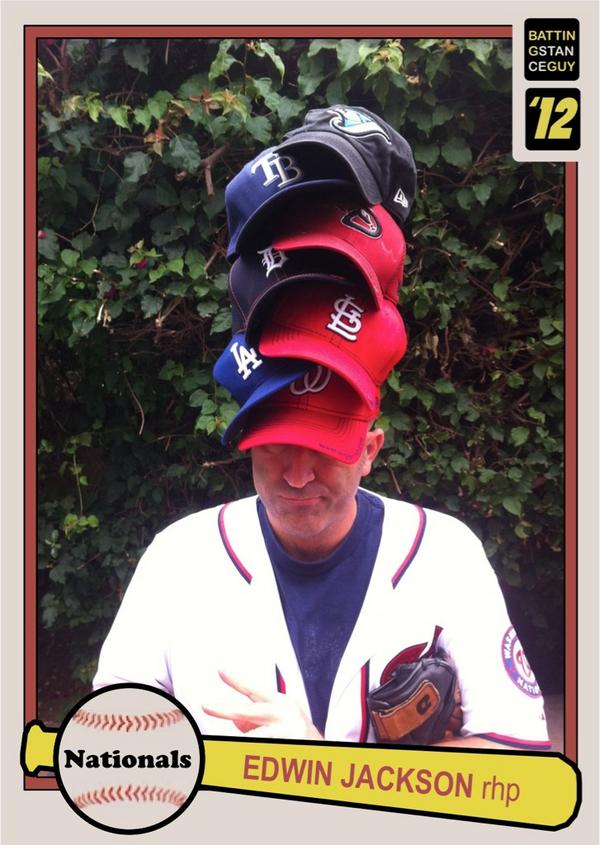
"Up in the Air," Professional Baseball Edition


Embedded image permalink
Don't Know if George Clooney is
"Attached to the Project" as Yet

ESPN is reporting that journeyman pitcher Edwin Jackson has signed to pitch for the Chicago Cubs in 2012, after agreeing to a four year, $52 million deal. The move means that Jackson will be pitching for his eighth team in 10 years (and ninth, if you count his fifteen minutes on the Toronto roster).

That's a lot of airline miles.  Rick Nelson was less of a travelling man.

A couple of thoughts.

  • This generation may have found its own Mike Morgan, who played for a baker's dozen in his 20 year career, one of them being the Cubs
  • Will Jackson, with his four year deal, know what to do if he's not packing up and moving in November?
  • Edwin will be wearing a new uniform this spring for the fifth straight year.  THAT is impressive.  It's not as impressive as Dave Kingman playing for four teams in one season, or Joel Youngblood, playing  for two teams on the same day, but not bad.
  • I'm in the wrong racket.  In a single season, Jackson will make $13 million.  "Mediocre" is one of many words to describe his performance to get that payday. Lifetime, the guy is 70-71, with a 4.40 ERA.  Last year, pitching for a playoff team (Washington), he went 10-11.  C'est la vie.
  • I feel better that the Blue Jays shelled out $25 million for R.A. Dickey, a mere $12.5 per season.  Dickey won the Cy Young last year...


Say Wha? Nero Continues to Fiddle in Sacramento

California Treasurer Bill Lockyer Calls the Tunes

Just checking in to see the latest foolishness on the soi-disant "fiscal cliff" (TM) at Yahoo Finance, and I came across this little tid-bit.

Bill Lockyer, the current treasurer for the economically sinking state of California has "warned" various i-banks (Credit Suisse, Black Rock) that he would use his power to push the state's two largest public pension funds to "get out of guns," whatever that means.

Now, aside from the irony of a thoroughly bankrupt state employing a political goon like Lockyer to be the "treasurer" of a vault full of IOUs, I marvel at the apparent lack of awareness of a man whose job ostensibly overseeing CALPERS is to provide for the old age pensions of public employees, not to moralize about investment in legal corporations selling legal products.

If I were a school teacher, housing inspector, or clock puncher at Cal Trans, I would be less than thrilled that this guy is not thinking of my best interest when making investment choices.  I might even think of filing an action of fiduciary conflict.


Wednesday, 19 December 2012

The New Math (Reloaded)


"It's the new math.  New-ew-ew math.
 It won't do you a bit of good to re-view math.

 It's so simple; so very simple.
 That only a child can do it."

                      -- Tom Lehrer


Ah; the Christmas season.  The tree is trimmed.  The presents are mostly wrapped.  Wassailing is mostly done.  The new year is around the corner.  And the fiscal cliff approaches.

Well; that's not -all- true.  Who goes wassailing anymore?  And what is it, anyways?
But oh, the fiscal cliff; truly, the most wonderful time of the year.

I read today on the financial blogs that the House speaker John Boehner has not presented a "Plan B" to the president, including tax rises on families making $1 million and more.  Taxes on "the rich" will go up, apparently.  Hell, the plan was one floated by Nancy Pelosi last year.

So of course, we've got a deal, right?  The president immediately accepted, and the two then really did dash out to go wassailing.

Well, not quite.

The recalcitrant president has indicated that he would veto such a plan, despite talking ad nauseum for the past 18 months about the need to raise taxes on "millionaires and billionaires."  

Now that such a tax is in front of him, he flatly turns it down?

Because, apparently, there are not enough (or any?) 'cuts' in Boehner's plan.

You read that right.  A DEMOCRATIC president refuses a REPUBLICAN proposal to raise taxes on millionaires because it doesn't have enough CUTS to spending.

We're really through the looking glass, aren't we?

But as nutty as all of that is, the best part is that White House communications director Dan Pfeiffer opined that the two sides were "only a few hundred billion apart," with hope a deal could be reached.

So, in Washington DC, where a millionaire is not a millionaire, now a few hundred billion dollars is now a trivial difference.

We're doomed.