Friday, 14 September 2012

Make a Wish


Today, ESPN-dot-COM have an interesting thought exercise on their web site.  They asked a number of baseball players and celebrities a 'turn back the clock' question - if you could pick a single game in the entire history of Major League Baseball, and go back in time to see it, which game would you select?

If you could go back in time and see any baseball game, what game would you choose and why?
You can pick from any game from baseball history, any game at all. It can even be one you saw in person but would like to see again.

The one stipulation was to apply the Wrinkle in Time rule - that is to say, you cannot alter history in any way (other than that, perhaps, you were not alive or in attendance on that day) - the outcome, the play, the weather, the stale, over-priced hot dogs and warm beer would remain as they were.

According to their survey, the single most chosen game amongst players, celebrities, and their own staff was the 1947 Brooklyn Dodgers - Boston Braves game in which Jackie Robinson made his debut as the first black player in the big leagues.

My reaction to this is, "really?  No; REALLY?"

Of all the games ever played - the Game 6 of the 1975 World Series, the 1960 Pirates/Yankees Game 7, the May 1979 Cubs/Phillies 23-22 game, the 'Bloody Sock" performance of Kurt Schilling - the Jackie Robinson game would be the single game you would want to see?

Not to diminish the significance of the game, and at the risk of wandering into territory that is to say the least impolitic, I find this response to be an admixture of equal parts political correctness and dishonesty.

The importance of Jackie Robinson, both to the game of baseball as a historical talisman, should not be understated.  His breaking of the so-called "color barrier" was a pivotal moment in the fabric of our country, and that deserves some consideration.

But was the game itself really worth consideration beyond the list of memorable contests?  From the perspective of play, the answer has got to be no. I can think of dozens of games, easily, that offered more on-the-field drama or excitement.

Doubt it?  Quick - tell me who won the game, and what was the score?  Don't Google it before answering. (Answer to be provided at the end).  I am guessing that nine of ten people, to be conservative, cannot.

Perhaps it's due to the historical significance of the game?  But if that's the case, is it more significant than the first game?  The first American League game?  I would argue that the first professional game would be at least as significant as the Jackie Robinson game.

Maybe the interest implied is so that the person could claim that he was at the game when it happened.  OK.  But that seems the answer to a different question, don't you think?

Jackie Robinson was a great player, and his appearance was a significant milestone, but I think this sort of almost forced reverence makes more of him in history than he was in life.  And that in my opinion, diminishes rather than elevates his legacy.

(Answer: In Jackie Robinson's first game on 15th April 1947, the Dodgers beat the Braves 5-3, in front of just 12,623 fans in Ebbet's Field).


Wednesday, 12 September 2012

Irresistible Forces, Immovable Objects, and Our "Rights."


Read today an op-ed from the Sunday New York Times; investigative journalist Bill Lichtenstein published a piece entitled "A Terrifying Way to Discipline Children."  In the editorial, Lichtenstein notes the rise over recent times in the use of "isolation rooms" and restraints in public schools as a means to discipline otherwise seemingly uncontrollable children. Included in the piece is a personal comment about the experiences of his then-kindergarten-aged daughter "Rose," who apparently was subject to such punishments on several occasions.
IN my public school 40 years ago, teachers didn’t lay their hands on students for bad behavior. They sent them to the principal’s office. But in today’s often overcrowded and underfunded schools, where one in eight students receive help for special learning needs, the use of physical restraints and seclusion rooms has become a common way to maintain order. 
According to national Department of Education data, most of the nearly 40,000 students who were restrained or isolated in seclusion rooms during the 2009-10 school year had learning, behavioral, physical or developmental needs, even though students with those issues represented just 12 percent of the student population
It's an interesting, if not to say eye-opening read.  And needless to say, I do not support the abuse or torture of children.

But one reaction I did have is this: after 40 years of "mainstreaming" children with learning, mental, and behavioural problems, ostensibly because it is the right of all to be treated "just the same as everyone else," where does one draw the line when circumscribing the rights of one child versus the rights of another?

In reading Mr Lichtenstein's story, he reveals, among other things, that his daughter has "speech and language delays," and at times becomes "fidgety and restless when she is unsure of what is expected of her."  Furthermore, it is revealed that "Rose" on occasion throws "violent tantrums" and at school became fixated with a scene from the cartoon "Finding Nemo," where sharks repeatedly (and violently) attempt to attack the story's eponymous protagonist.

"The school provided no solution," Mr Lichtenstein offers, dryly.

I am the parent of a small child - one who is NOT prone to "violent tantrums," nor bouts of "fidgety or restless" behaviour.

Where do his rights (and the rights of the other students in the class) come into the equation here?  When a child is repeatedly disruptive, not to say violent, that has a consequence for the others in the room whose learning is, at the least, interrupted.  Each time the teacher has to stop and tell "Rose" or other students to be quiet, to return to their seats, not to throw a tantrum or hurt the other children, that infringes on the rights of every other student in the classroom, doesn't it?

I am not a proponent of group rights - at all.  As I see it, we do not have collective rights, but rather, individual rights.  Amongst those rights, for school children who are compelled by law to be in the classroom, is the opportunity to be educated by a professional.

I'm sympathetic to "Rose" Lichtenstein, and to a lesser degree, her father.  Really, I am.  But if we disavow "time out rooms" for repeated bad behaviour, whilst at the same time insisting that public school classrooms are appropriate for all children, how do we expect our teachers to teach effectively?


Tuesday, 11 September 2012

Does Time REALLY Always Fly?


Today is the 11th of September 2012; the numerical representation ("9-11") will immediately resonate with most of us in the USA as well as the Western world, and likely a large chunk of the rest as well.  Of course, it's the anniversary of a terrible day eleven years ago when several groups of men, using vessels of commerce , leisure, and transport, destroyed the World Trade Centre in Manhattan, a section of the Pentagon in Washington, several thousand lives.

It's become something of a grim tradition on this date - people posting "where I was" remembrances of that particular date when they heard/saw the news. I was living in San Jose, California; my day had just begun with the familiar voice of the bumper announcer on KNBR, broadcasting the top of the seven o'clock hour news teaser - "If you've ever been to New York and seen the World Trade Centre, it's gone...."  Unlike many here on the east coast, my day did not begin just like any other.

Maybe it's the distance that an entire continent made; perhaps it's that at that time, I had only seen the Twin Towers out the window of a plane landing at Kennedy Airport.  But as I read the comments of those who are now my neighbours here in New Jersey, just an hours' drive from NYC, I find it odd the feeling "it seems like only yesterday."

To me, it seems like a lifetime ago.

The distance between then and now is temporal and metaphorical.  EVERYTHING about my life is different.  I suspect the same is true for a lot of people.

Honestly; think about the way you felt when you went to sleep on the night of the 10th of September 2001.

The country felt more prosperous. There was no lost decade economically.  No stock market crash (two, in fact, if you count the Tech Bubble).  The fear of shadowy bad guys waiting to hit at us was constrained to Hollywood movies.  There was no Iranian bomb.  We wished for a continuation of the good times - "hope" was not tied to "change."

Worst of all, no decade of seemingly endless, hopeless wars.

Personally, there is practically nothing about my life that is the same today as it was then.  In the time, I've gotten married, changed jobs (three times).  My son was born, grew, and entered school.  I now live thousands of miles away.

It doesn't seem like only yesterday to me, and in a sense, I am glad for that.  I haven't forgotten - nobody should forget of course.  But as I see it, the best way we can celebrate and remember those who were killed that day is for us to live.

Friday, 8 June 2012

Reflections on 10 Years

If We Were Polydactyl, Would
11 Be the New 10?

Today marks the 10th anniversary for my wife and me (we were wed on the 8th of June 2002 in Los Altos, California; a beautiful, sunny Saturday).

As I am getting older, I get the feeling that time is accelerating.  It's a common feeling, from what I hear.  "Every year is getting shorter," as the Pink Floyd song goes.  A lot of water under the bridge - four different jobs, two industries, two states (we now live in Princeton, NJ, having joined the flood of middle class families haemorrhaging from California's borders).  One little boy.

I am thinking about the significance of numbers.  In every culture, of course, numbers carry certain sub-texts.  In the west, for example, seven is considered lucky (not sure why); 13 unlucky (depending on the source, reasons vary from the number of attendees at the Last Supper to the date that Pope Clement ordered the "disposition" of the Knights Templar).  In east Asian cultures, six, eight, and nine are considered auspicious (the words are homophones for "long lasting," and "wealth."), while four is considered very bad news (it sounds like the word for "death.")  In many hotels in China and Japan, there is no fourth floor.

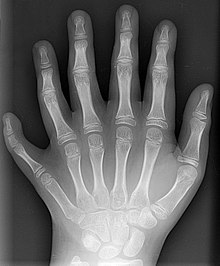
10 carries a certain symbolic weight, as do 100, 1000, etc.  I believe that this is owing to the fact that we live in a base ten world (that is to say, mathematically, we count from zero to nine, and then move the next place, put a one, and start over).  This is almost surely an artefact of the reality that human beings have 10 fingers, save for certain polydactyls (people with extra fingers/toes).  If we had 11 fingers and not 10, then the "Spinal Tap" joke about 11 would be a lot less funny.

In statistical testing of hypotheses, something is declared to be "significant" if its p-value is less than 0.05 (the estimated probability of the event happening by chance being less than one in 20).  The standard was set by the father of statistical inference, Sir R. A. Fisher.  In a somewhat apocryphal story, Fisher commented that 0.05, as opposed to 0.04 or 0.06 or some other equally arbitrary number, was chosen because we have five fingers on each hand, and that seemed as reasonable as any other standard to him.

So, here's to 10 years great years, and hopefully many more.


Thursday, 31 May 2012

Do I Feel a Draft?


One Tin Soldier Rides Away

The baseball amateur draft is approaching (next week).  While not the hyped-up spectacle that the circus of the NFL draft has become, it is a significant event in the baseball world.  Set up in the 1960s as a means of providing the lower-tiered teams with an avenue to succeed (Rick Monday, I believe, was the first player ever taken), the draft is the primary way that teams fill their pipeline with young talent.

Unless you're the New York Yankees.

I wrote a couple of comments here and here about the way that the Yankees - and to a lesser degree the Boston Red Sox - have become locked in a battle of high priced Hessians to fight for the American League pennant year in and year out.  This summer seems to be shaping up to be no different, despite a poor start by both.

Over at ESPN.com today, their baseball blogger David Schoenfeld has written a quite interesting piece about the all-time best "rosters" of players taken by each AL East franchise.  It's curious to look at the Yankees, and just how, to be kind, mediocre their takings have been.  Derek Jeter and Don Mattingly are obviously tremendous players, the former headed to the HoF on a first ballot.  Andy Pettite is a borderline case for the Hall, and Ron Guidry was an excellent pitcher until arm problems hurt him.

Beyond that, the Yanks have not been spectacular, and could reasonably be said to be the poorest performer in the division in this regard.  The writer points out that in the nearly 50 years of the draft, the Yankees have not drafter a single outfielder who has become an All Star for the Yankees.  Not one.

Between the lines, it seems obvious HOW the Yankees have built and maintained their dynasties, by signing veteran players or trading away - in many cases trades forced by economics on the small market teams - for established stars.

Schoenfeld writes the obvious question - what would become of the Yankees if other teams simply stopped trading with them?  I am not sure the answer, and the question itself is an exercise in rhetoric, since such an embargo will not happen.  Ever.  For one thing, the finances of the game force teams in many cases to trade their top talent (my team - the Toronto Blue Jays - three years ago were forced to deal the best pitcher they've ever had, Roy Halladay, for a grab bag of nuts and bolts), and reality dictates that if the Yankees are kept out of this market, that has an impact on the quality that teams can command.


Friday, 18 May 2012

Escalating the Culture Wars


I've been somewhat casually following the truly sad story of Trayvon Martin, a teen who was shot to death in Central Florida a couple of months ago. Depending upon whom you ask, he was either killed by a racist vigilante or a fed-up homeowner who was mad as hell and not going to take it any more.

Subsequent to the killing and initial lack of action by the local police in Sanford, Florida, the story has become muddled, as politicians, newspapers, and of course, the occasional dim-wit celebrity interposes himself in the case, further moving us from a rational look at what exactly happened.

As I wrote in this post back in March, I believe that the root of the problem is the facility with which guns may be obtained.  I stand by this view.  Cutting away the non-sense about whether Martin is 6-4, looked menacing in his "hoodie" sweatshirt, is being falsely portrayed in the media as either an angelic, 12 year old or a pot-smoking ganster with gold teeth, the issue here is that a man (George Zimmerman) was able, despite more than one run-in with the law, to obtain a concealed carry permit, took it upon himself to cruise his neighbourhood, disregarded the orders of local law enforcement to stop pursuing Martin, provoked an altercation - needlessly as I see it - and ended up killing a 16 year old boy in, ostensibly, self-defence.

The fight did not need to happen.  The shooting did not need to happen.  Neither, I think, should have happened.

The thing I am thinking about today, as this continues to bubble, is a comment made elsewhere about how violent our culture has become; have we reached a tipping point, and if so, why?  A friend remarked that perhaps it's due to the numbness we feel with the omnipresent wars.  She observes that even Halloween, a children's holiday, is now festooned with graphic, dismembered body parts on the lawn.

I don't know if I blame the wars in Iraq and Afghanistan, but I do tend to share her view that our culture seems to be getting more coarse.  More nihilistic.  The cartoon violence of a fake body strewn across an October landscape bothers me a lot less than the puffed-up, faux machismo that masquerades as "manhood" today.  The whole culture has moved into a direction where the "ideal" is a callous, steroid-fuelled, confrontational jerk who cannot put a complete sentence together.

It's I suppose an extreme example, but for those old enough to have played with Star Wars dolls, er, "action figures" from the 1970s and 1980s, compare the Mattel Han Solo or Luke Skywalker figurine from the original set, to what each looks like now.

Better still, compare the movie "The Man Who Shot Liberty Valance," where the gunning down of the bad guy is treated as a somewhat ambiguous "good," with the recent hit "The Girl with the Dragon Tattoo," where  the heroine exists in the sea of a violent revenge fantasy.

I find it instructive that post-feminist entertainment - a reflection of our culture - has taken the idea of a "strong woman" (perhaps Sally Field from "Places in the Heart") as one who faces real challenges with grit and determination, and replace her with "Salt."  My wife will laugh when I use the word "tough guy chick," but I think it's in part true (and I think, dangerous) to instill the idea that a strong woman is one who totes a gun around and either bludgeons, karates, or shoots/blows up her enemies.

In a nut-shell, we've become so hyper-masculinised that even a woman is supposed to kick ass and take names.

THIS is not progress.

In fact, to me it seems the opposite - a thousand years ago, we picked mates in ways similar to the way apes and monkeys did - based almost exclusively on brute force.  Over time, we came to value other qualities - reliability, intelligence, imputed faithfulness.  We seem to be regressing back to the old days.

An interesting take by evolutionary biologists was written recently around the HBO show "Girls."  The rather long-ish piece takes a look at the implications of the new mating dance, both for men and for women.  If you follow the arguments of, say, Richard Dawkins, the future is not going to require sunglasses, I think.

Thursday, 10 May 2012

The Evolution of a President: Profile in Courage, ca 2012


I am ahead, I am advanced
I am the first mammal to make plans, yeah
I crawled the earth, but now I'm higher
2010, watch it go to fire
It's evolution, baby
Do the evolution

-- "Do the Evolution"


Yesterday, President Obama stated out loud what many of his political opponents on the right have suspected, and many of his supporters on the left were suspicious of - namely, his belief that "(s)ame-sex couples should be able to get married."


The reactions are predictable.  Those who are inclined to vote against Mr Obama's re-election in November have reacted by citing his social liberalism as another example of his "assault" on traditional values.  Those who are inclined to see him re-elected in November are praising his "courageous stand" on the issue.


My own opinion of the former, as someone who makes no bones about my right-wing views, I would just say that it's my strong belief that denying same-sex couples the legal protections of marriage is wrong-headed and in many cases, little more than barely-concealed prejudice.  As I wrote a couple of years ago, in reflecting on the issue:

How are we treating our fellow man?
The answer to that question is far more relevant in my view than any Propositions we sign or lawmakers we call to defend marriage against a threat that just does not exist.


It's my firm belief that in a generation, we are going to look back on the battle over this "issue" with a mixture of disbelief and embarrassment, if not outright shame.  

The proximate furore surrounds the vote on Tuesday in North Carolina to put into law statements denying that marriage can be extended to same-sex couples:

Marriage between one man and one woman is the only domestic legal union that shall be valid or recognized in this State. This section does not prohibit a private party from entering into contracts with another private party; nor does this section prohibit courts from adjudicating the rights of private parties pursuant to such contracts.


The vote does not actually accomplish anything - same-sex marriages are not performed in the state. The legislature and governor are very unlikely in the near-term to pass laws to the contrary. For all intents and purposes, the status quo in North Carolina on Wednesday morning was exactly the same as it was on Tuesday night.. 


What the vote does "accomplish," so to speak,  is put into law  a mean-spirited commentary from the majority in that state. It's little more than a cruel, rhetorical statement. 


As I see it, this deserves condemnation. In plain, unequivocal language.


Mr Obama, due I suspect to pressures from wealthy supporters, has done is to issue a somewhat tepid support of gay marriage.  24 hours after the vote.  Additionally, he was somewhat pushed into such a statement due to the comments of his Vice President, Joe Biden, who earlier had issued a much stronger statement supporting equal rights for gay Americans.

Is this "courage?"

Not in my book.

Chris "Shiver up My Leg" Matthews, perhaps the most reliable lap-dog for the president, ended his show yesterday talking about the courage Mr Obama has shown, referring to the remarks of the president as "historic."

Could there be a grander canyon between these two men: one fully in support of the right of gay people to marry, one totally against that right
I honor a president who regardless of the political consequences declared for all the world to hear that all God’s children have the right to love as they were born to love. That ought to count for something no matter which way the chips fall in this election.


Only, that's not what the president said as he continued to waffle. Mr Obama initially responded that he was "disappointed" in the outcome.  And in the remarks Chris Matthews was praising, the president stated that he sees the issue primarily as a states' rights issue.


This is typical of the sort of phony leadership that Mr Obama has provided.  Grandiloquent words that amount to little more than hot air, but precious little substantive action.


So, I ask - if he supports "the rights" of same-sex couples to marry, but sees the issue as one that the states ought to decide, how is he substantively different from the language in the "Defense of Marriage Act" that he has been praised for refusing to support?  The outcome of his "evolved" views is that precisely what happened in North Carolina Tuesday - it went to the states, and the states said "no."


Mr Obama has said before that he does not view marriage as a civil rights issue.  His recent evolution leaves him approximately where Dick Cheney was four years ago.  This is hardly "courageous" for a politician who owes his position to progressive activists.


I would think that, after all the work, all the organising, and all the money that gay rights activists have contributed to the president, that they deserve a bit more.


I think that as full American citizens, they certainly do.

Thursday, 3 May 2012

The OCD, Random Walk Post of the Year


I'm basically a pretty simple man; my thoughts, when not of wife, son, family, or job, tend to wander towards politics, sports (mostly baseball), travel, and numbers.

This random walk ties at least of few of those together.

We recently returned from a trip to Hawaii and California, which was my home state for most of my adult life.  Our rental car had the California licence plate 6YSE842.  Not terribly interesting. At least to the real "99 per cent" of people.

But it got me to thinking.

California, like many states, issues its licence plates in alpha-numeric order.  Very soon, the state will exhaust its supply of plates of "6" series (i.e., 6ABC123), and roll into the "7" series.  I am not sure when the final allocation - 6ZZZ999 - will be stamped and issued from Sacramento, but if it hasn't, it will in all certainty be in 2012.

Also, like many combinations - and area codes come to mind - there is a finite number of number/letter combinations.  For six digit plates, that's 26**3 (for the ABC portion) x 1000 (for the 123 portion).  That's approximately 17.5 million combinations, though I suspect some embarrassing three-letter combinations are not made.

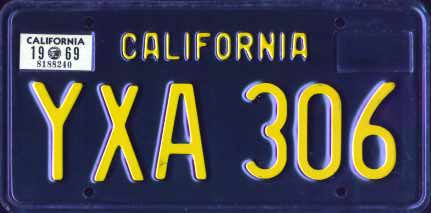
When I was born, California had just reached the end of its famous "black plate" run (yellow letters/numbers stamped on a black, steel base).  ZZZ-999 was issued in late 1969:

CA 69 #YXA 306
Sample California "Black Plate" from 1969

These plates are considered highly collectible to classic car owners, largely because in 1970, when the next series was issued, the state no longer required owners to surrender their plates to register.  Hence, a car that had been purchased during its run (1963-1969) and has remained in the Golden State, will likely still sport its California bona fides to prove it's truly a "California car." 

In 1969/1970, with all 17.5 million combinations issued, the state swapped the order from ABC-123 to 123-ABC, and issued its iconic blue and gold set:

CA 69 #194 AAI
The Plate that Made California Famous

Incidentally, this is the format/colour that the licence plates took when I was a small child living in Southern California.

This change bought Sacramento some time, but by 1982, the California DMV had again reached its limit, and faced a formatting challenge.

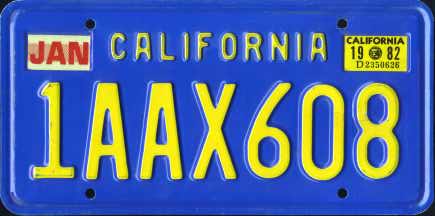
The solution was to revert back to the ABC-123 formats used between 1956 and 1969, but with a twist.  A seventh place-holder was introduced at the start, and the 1ABC234 format was born.  The base plate of gold on blue was kept, but the state had crossed the seven-digit rubicon.

CA 82 #1AAX608
The Plate that Saved Sacramento

This numbering format has been in place ever since.

So, between 1956 and 1969, California used an ABC-123 scheme.  Approximately 13 years.

From 1969 to 1982, a 123-ABC scheme sufficed. Again, about 13 years.

The state, needless to say, has continued to add people, and thus, drivers.

The '1' series (basically, an entire ABC-123 run) was exhausted by 1988.  Six years.

The '2' series concluded with 2ZZZ999 in 1992.  Four years.

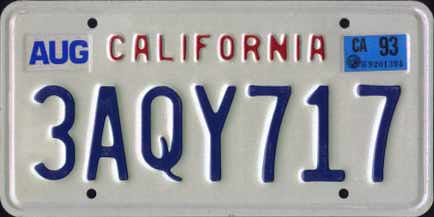
My first car was registered in February 1993, 3BXE321.  I purchased another vehicle and registered it in October 1995; its plate was 3TSR355.  I rolled a "4" series plate (4DNT473) in June of 2000, and a 5 (5EXE236) in November 2003.

CA 93 #3AQY717
My Very First Car Had This Rather Boring Format

I've done some quick calculations, and the state basically is exhausting its runs every 3.7 years or so.  Put another way, in just about 11 years from now, the final seven digit plate - 9ZZZ999 - is going to be stamped.

I may be alone in being curious to see what scheme the DMV are going to try.


I Read the News Today; Oh Boy!


The president has sponsored a web site - I suppose to foster support for his re-election - depicting the imagined life of a CGI-generated person.  The hypothetical person is dubbed "Julia" in the spot.

It's perfect, really.  A made-up person, created to win four more years for a Walter Mitty president, using make-believe accomplishments as evidence.

Aside from the general creepiness of the ostensible cradle-to-grave socialism ("the government" enables utter bliss for "Julia" at each step of the way) and flat-out twisting of reality ("Julia" remains as a student on her parents' medical insurance - part of the "reform" forced on us - until she is 26.  Yes; there are PLENTY of people who spend EIGHT YEARS in college.  Like Senator Blutarksy.  But then, Bluto only had "seven years of college down the drain.") is the choice of name for the fake person.

The Future Senator, Who Now Can
Remain on his Parents' Insurance

"Julia" is the name of a Beatles song, written by John Lennon about his mother.  The opening line, "Half of what I say is meaningless."

Who said Mr Obama has no sense of irony?


Wednesday, 2 May 2012

Strictly by the Numbers (Almost)


The first month of the baseball season (plus one game) is in the books.  The Blue Jays ended April at 12-11, with a 4-1 loss to the Texas Rangers and their Japanese-Iranian (how often do you get to say that?) phenom Yu Darvish.  The Rangers paid more than one hundred million dollars to get Yu, who has thus far impressed.  Toronto had been in the running for his services, but as it turned out, nine figures, US, was a bit too spendy.

Anyhow, the Jays are now 13-11 after last night's improbable come-from-behind win that featured another blown save by Francisco Cordero, three home runs - of which two hit the top of the wall before exiting the SkyDome, and four (4) GIDPs.

The Jays have muddled through 24 games, a couple of games ahead of where they were last year, (11-13) at this stage.

With the four double plays (and it could have been five had the Rangers brought any semblance of a defence to the game), Toronto now leads the majors in GIDPs, with 27 in 24 games.  Only two other teams (KC and Florida, er, Miami) have more than one GIDP per game.

The bullpen has converted only four saves in 10 opportunities.  Only one other team - Anaheim - has as many games wasted by the bullpen.  I wonder if the GM has Tom Henke's number?  Can The Terminator still pitch despite pushing 60?

For those un-initiated in the confluence of small sample sizes and high variance, the Jays have at this point largely done a 180 degree turn from last season.  In the first week of May 2011, the team could not win a day game, playing 3-13 under the natural light of the sun.  This year, they are 8-2.  Under the lights, in May 2011, Toronto was 12-6.  With last night's win, they are now 5-9.  Pretty close to a total reversal.

It's a long season, and with the Yankees starting to show some age, Boston appearing close to a civil war in the clubhouse, and the addition of an extra playoff spot, who knows?

If the 3-4 hitters (Bautista and Lind) can get their collective batting average above the Mendoza line, and the bullpen can be convinced that they are not out there to throw BP, this may be the year.