Showing posts sorted by relevance for query humanity. Sort by date Show all posts

Friday, 8 September 2017

Ex Machina, In Our Image


 I'm an insect who dreamt he was a man and loved it. But now the dream is over, and the insect is awake.
-- Seth Brundle, protagonist of 1986 sci-fi flick, The Fly


In the children's classic The Wonderful Wizard of Oz, there is perhaps no character more tragic than the Tin Woodsman (in the book, his real name is Nick Chopper). His story is glossed over in the 1939 movie that derived from the book, but shortly, Chopper was once a man of flesh and blood who came from a family that earned its living chopping trees to make lumber for the sale in Munchkinland. Alone following the death of his parents, he eventually found a love, and proposed marriage. The girl to whom he was engaged was a handmaiden to an evil woman who feared losing her services. The old woman made a deal with the Wicked Witch of the East, who cast a spell on the ax of Chopper. Each time that the ax was swung, rather than striking its targets, it chopped off an arm, a leg, which was replaced by a prosthetic one made of tin.

Eventually, Chopper came to be made entirely of tin after quite literally, cutting away every ounce of his human form.

I thought of the Tin Man as I read this article in the New York Times, which describes a current "ethos" common here in the San Francisco Bay Area. 

The term "hustle" is making its way into the local lexicon, used to describe essentially the desire of younger "entrepreneurs" to set aside family, friends, vacations - their youth - in order to be the next internet billionaire star.

From the piece:


“Hustle” is the word that tech people use to describe this nerd-commando lifestyle. You hear it everywhere. You can buy hustle-themed T-shirts and coffee mugs, with slogans like “Dream, hustle, profit, repeat” and “Outgrind, outhustle, outwork everyone.” You can go to an eight-week “start-up hustle” boot camp. (Boot camp!) You can also attend Hustle Con, a one-day conference where successful “hustlers” share their secrets. Tickets cost around $300 — or you can pay $2,000 to be a “V.I.P. hustler.” This year’s conference, in June, drew 2,800 people, including two dozen who ponied up for V.I.P. passes.

I'm decidedly outside the target demographic, of course. But to me, "hustle" is not a recipe for success. It's not a euphemism for "workaholic".

It's a con. It's a one-word synopsis of "I'm a dysfunctional human being who cannot relate to human beings in any sort of real way, so I pretend my imitation of some pointless 'app' is going to disrupt the world to salve me missing soul."

I think a lot about so-called "artificial intelligence" (AI), and have written several times about it. There is a great fear that machines, ultimately, will replace us. I cleave to the school of thought advocated by John Searle that 'real' (strong) AI is not going to happen. Not soon, anyways. Machines capable of thinking in any real sense that can perfectly copy humanity are not on the horizon.

Of course, they do not have to be.

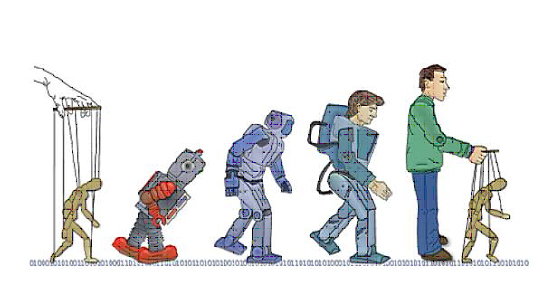
But this is the first time I've really thought about the opposite. Not machines that copy human beings, but humans who simulate machines.

The primary character in the 1986 The Fly film accidentally melds his DNA with that of a house fly in an experiment trying to teleport himself, with catastrophic consequences. 

The Tin Man ends up a mechanical thing longing for a heart through the malice of a witch.

But in Silicon Valley, young people, eyes wide open, are voluntarily chopping away their humanity. This, I had not considered.

Machines will not copy people; but if we ourselves become machines? 

The Tin Man is said not to have a heart, and goes off to Oz to seek one from a charlatan wizard. One of his fellow travellers, the Scarecrow, is said not to have a brain.

Menlo Park's Yellow Brick Road - Sand Hill Road - may lead to an Emerald City filled with VCs. But those who voluntarily give up their humanity are going to find that it does not lead to any wizard. Those who trade away their humanity to a false wizard's promise of worldly "disruption" are, to me, equal parts Scarecrow and Tin Man.

They are giving away their hearts - and their youth - so that they can deliver a better way for you to order a pizza and track it with your mobile phone. And as a bonus, you can do it without ever having to deal with the unfortunate nuisance of human interaction. A drone will drop it at your front door.

I was once 25 years old, living in the Valley; I worked for seven years in a "start up," and at times worked ridiculous hours in the pursuit (with my colleagues) of  'disrupting' the world (we didn't use the word 'disrupt' 20 years ago, however). Like many today, I reckon part of that was because I had few friends beyond the company, and went home (when I did) to an empty, quiet house. Work filled up a void. I suspect that this has not changed. 

The road may (for some) lead to wealth; for many others, it will not. For both, they may find (when they get to my age) that what was given up is not worth what was gained. They will discover that the world that they disrupted was their own.

In the end, the real Tin Man got his heart, of sorts. But at the end of Sand Hill Road, there is no wizard, and there will be no missed youth to be returned, magically, from an otherwise empty bag.


Tuesday, 25 July 2017

Au Delà Je Suis Charlie


One of the gifts - and curses, I suspect - of age and the passage of time is a certain creeping circumspection of things that we had not considered as young people. These days find a growing chorus of noise about artificial intelligence, the place of machines, and what is to become of human beings when our creations can outreach us.

I think a lot about what it means to be a human being; what defines our humanity, what rights does it afford us?

And what obligations as well?

Today is a significant day for our family, personally. 23 years ago I lost my father after a short battle with cancer. This is, as I have said before, the last year of my life that my dad will have been in it for more than half. (Next year, I will be 48, and my father, gone for 24 of those 48 years).

My dad battled his cancer as he could, attending radiation therapies, walking each day when he could to build his strength, and enduring a course of chaemotherapy. All, ultimately, could not help him. 

I've been somewhat casually (if I am being truthful) following the story of little Charlie Gard, a tiny little boy born in England last year, afflicted with a horrible genetic condition called "infantile onset encephalomyopathy DNA mitochondrial depletion syndrome." Little Charlie was apparently a normal, healthy baby when born, but who, a month later, began to display symptoms of weakness. He had difficulty lifting his head.


The disorder is a terminal one that rapidly depletes the mitochondrial DNA (mitochondria are, in layman's terms, called "the power plants of the cells"), resulting in initial weakness and eventual systemic failure. No curative treatment is available, though there are experimental therapies involving nucleosides that may prolong life and improve the prognosis.

Research is primarily in the USA, and funds were quickly made available through "crowd" and other sourcing to pay for the expenses of bringing little Charlie to New York. However, the law in the UK intervened - the doctors at the famous Great Ormond Street Hospital reckoned that the treatments, which are not curative, would not improve Charlie's quality of life. His parents disagreed, and the courts ultimately sided with the hospital.

Charlie would not receive the experimental treatment, and later, when his condition deteroriated, the Court again sided with the hospital (against the wishes of the parents) to remove life-support from the baby.


Today, Charlie is in the news once again - his parents, having exhausted their appeals, have asked to bring their son home so he can die there rather than in a hospital. Incredibly, the hospital again argues against the wishes of the parents, and the Courts once more will decide.

I confess that I do not know enough about the science involved to render an intelligent opinion of what, medically, is 'best' for Charlie. While I am not a medical doctor, I am a parent, and I can only imagine the horrible position his parents are in.

As a personal aside, during my wife's pregnancy with our son, at one point an ultrasound revealed potential "soft bio-markers" for trisomy-18, a catastrophic genetic condition that is prenatally fatal in more than half of all cases, and fewer than 1 in 10 infants survives to his first birthday. Our son was healthy in the end, but waiting the three days for further test results is, honestly, one of the most terrible times in my life. I am and will be eternally grateful that we were not forced to confront horrific alternatives.

As fate would have it, little Charlie Gard and my father share the same name.

It's, again, not my point to argue what the process in the UK is, or that the Court has made an error. 

But I am troubled, again, by questions of what defines our humanity. What obligation do we have to those who, literally, cannot speak for themselves? Who could be more helpless than a newborn? Who, more deserving of our protection?

I am haunted by the images I have seen of a robed, bewigged judge telling a mother and father that, no. Your child is not going to be allowed, despite your wishes, to be taken for an experimental treatment that may (but also may not) help him. 

Is little Charlie suffering? Would extending (or not?) his life further that? I have no idea - but I doubt that Mr Justice Francis does, either. I have a sneaking suspicion that part of the debate is with an eye towards allocating precious health care resources in resource-constrained environments.

In another context here, I read a French philosopher and ethicist called Chantal del Sol, state that motherhood is
...not the making of a baby in utero through the act of insemination.  A child is not a product, or a thing; it is not an object, but rather, a person.  That is why we have a word - procreation - to distinguish birth from say, a glass-maker or a manufacturer.


Human beings are not products. 

We hear a lot these days about this or that "right" that each of us does or does not have. I agree with some, but more often than not, what I hear are "rights" more or less boil down to "you have to pay for my choice to do X."

The most fundamental right we have as living beings is the right to live. What I feel is a real measure of our humanity is how we stand up for the voiceless. The truly weak.

I cannot help feel that, in this case, humanity did not perform terribly well on that test.


Tuesday, 12 August 2025

God and Man (and Machine)

The past year or so has seen an incredible explosion about "artificial intelligence" (AI). Much of the discussion has focused on potential threats to humanity from machines - job losses, Terminator-style dystopian fantasies about the rise of SkyNet. Hackers.

Some of these threats seem more real than others (spoiler: the machines do not have to replicate human intelligence; they just have to be good enough. So yes. Most of the jobs of today are in fact at risk.)

But one thing I find intriguing is something not discussed.

What do we owe our creations.

A few years ago, the film Blade Runner was released. It is a movie based on the dystopian novel Do Androids Dream of Electric Sheep by the science fiction writer Philip K Dick.

The (brief) plot-line is that there is a race of androids called "replicants" that have been engineered with narrowly circumscribed super-human skills. For various reasons, the machines are banned from Earth, in part because (I suspect) of the apparent threats that they pose to people. The anti-hero of the movie is a bounty hunter named Decker (played in the film by Harrison Ford). It is the job of "blade runners" to eliminate any replicants that alight on the earth. In the novel (but not the movie), it is revealed that Decker himself is actually a replicant.

A question posed by the movie and increasingly now in our AI-evolving world is, is it moral for blade runners to hunt and kill replicants? 

What do we owe our creations? 

I’ve not seen the original Blade Runner in several years, but the question of whether it is “morally right” to kill the replicants - and the more existential question about what rights the replicants themselves have - is a terribly complex one in my mind’s eye.

Now, I’ve read some of Philip K Dick’s work. The question of what defines humanity itself is embedded in the story. I don’t recall clearly whether the replicants are in the film are revealed to be fully human, cyborgs (cybernetic organisms - part organic and part mechanical), or fully robots. In the book Do Androids Dream of Electric Sheep, the “replicants” are mechanical in nature.

It reminds me a bit as well of the movie AI: Artificial Intelligence. In that story, also of a dystopian future, human beings have created machines that increasingly simulate human beings. Like the replicants in Blade Runner, the machines are designed to fulfil specific “needs” of people. There are workers, sex robots, and of course, the protagonist of the story, David, who simulates a child for a couple whose natural-born human child is in a coma.

Both stories, to me, raise questions:

What defines humanity? Is it our physical, outward appearance? Our sentience? Our ability to feel (or simulate) emotions and empathy? Is it simply our DNA?

What responsibilities do we as creators owe those things that we create? I think about this from time to time in an eschatological sense - as a believing Christian, we believe that human beings were created by God himself in His image. Other monotheistic religions have similar systems of belief.

If God made man, what does God owe mankind?

The people in both Blade Runner and AI have created nearly perfect simulations of themselves, placed them on the Earth, and have responsibility for them. In some ways, this is similar to the relationship between God and man.

In a purely practical sense, most people accept that it is moral to defend the helpless, and in Blade Runner, Roy (the leader played in the film memorably by Rutger Hauer) has killed a number of people. Some, it could be argued, in defence; others in revenge (e.g., Tyrell, the head of the Tyrell Corporation, who make the replicants). Others for no reason really given (Sebastian, who befriends Roy and Pris). Roy is dangerous to people, some of whom have nothing to do with the creation and mistreatment of the replicants. In this sense, it is arguable that killing Roy is a protective measure, and thus is defensible.

In a larger sense, the issue of whether it is moral to create sentient humanoids simply to serve as slaves with intentionally short lifespans, and who are aware that they will die in approximately five years, must be grappled with.

So it’s a morally ambiguous situation that, beyond asking whether it is moral to kill the replicants, one should ask what responsibility we have to those things we create.

Like it or not, and John Searle to the side, we are getting close to the point where we, like God Himself, are making arguably sentient beings in our own image. So I suspect we should begin to at least think about what our responsibility to our creations might look like.

Friday, 17 February 2017

Ground, She's Moving Under Me


They made us too smart, too quick and too many. We are suffering for the mistakes they made because when the end comes, all that will be left is us. That's why they hate us.

One of the many moments of the (in my opinion, very under-rated) movie AI: Artificial Intelligence that sticks with me, a decade later, was the discussion between Joe and David, the protagonist of the story. Both, you see, were "mecha," mechanised human beings created for various "needs" of humans in the not distant future.

David, abandoned by his "mother," has determined that it is because he is not real, and seeks answers as to how he might become human and thus, regain her affections. Joe, designed for other purposes, tries to explain the situation to David, and does so starkly.

The past few weeks - indeed, months and years - have been quite tumultuous, both in the US and abroad. Yesterday, the new president of the USA, Donald Trump, held a somewhat rambling press conference, in which he lashed out at various news and other media outlets for creating "fake" news stories. He kicked the whole thing off with a declaration that he was left "a mess" by his predecessor.

Later last night, I was watching a brief debate between former Secretary of Labour Robert Reich (served under Bill Clinton), and libertarian economist Stephen Moore. Reich belittled Trump's claim that there is any mess, and cited a number of economic statistics - low unemployment, a booming stock market, job and wage growth - as evidence. His discussion wound up with the conclusion that Trump, economically, was left a "gift" rather than a mess.

I find this description from Reich, who now is a professor across the bay at UC Berkeley, odd, as he has for years been beating a basso ostinato about the growing gap of rich and poor in the modern economy. Apparently, that no longer constitutes a problem.

Mission accomplished.

Of course, the truth is far murkier than a 10 second political talking point, and the continued erosion of the American middle class represents a tremendous threat. The phrase "President Trump" attests to the rising anxiety, and that anxiety does not derive from whole cloth.

Yesterday, a vote was taken in the European Parliament in Brussels regarding the growing ethical concerns of the rise of the machines. (Apologies; the article is in French).

Over the past year or more, an increasing number of people, including voices who know like Elon Musk (Tesla) and Steve Wozniak (the real brains behind Apple), are warning of a potential dystopian future that real artificial intelligence may birth. Two years ago, Woz had this to say:

Like people including Stephen Hawking and Elon Musk have predicted, I agree that the future is scary and very bad for people. If we build these devices to take care of everything for us, eventually they'll think faster than us and they'll get rid of the slow humans to run companies more efficiently. 

Will we be the gods? Will we be the family pets? Or will we be ants that get stepped on? I don't know about that … But when I got that thinking in my head about if I'm going to be treated in the future as a pet to these smart machines … well I'm going to treat my own pet dog really nice.

The vote in the EU Parliament started a legal discussion of what the responsibilities of "thinking" machines should be. A fundamental axiom of western law is that guilt must be tied to understanding. To commit a crime, one must grasp it. With respect to conscious machines, if they are capable, they can be culpable.

Just how the law will deal with a robot who, perhaps motivated by jealousy or anger, destroys another robot? Kills a person? The EU is talking about these issues.

Equally, concerns about the future obsolence of mankind are now making the rounds. The evolution of our economy has always focused on creative destruction. But increasingly smart machines change that calculus in a fundamental way.

The argument since the rise of machines is that automation is part of creative destruction - the automobile put the buggy whip maker out of business, but created jobs for the mechanic.  The ATM reduces our need for bank tellers, but requires people who can make, program, and maintain the devices.

The central problem with this argument is the assumption that there is no upper limit to human abilities; that we will forever be able to create new occupations.  That does not seem to me a sustainable view.

Machines that can function as lawyers or doctors - they will need people to make, train, and maintain them.  But I suspect not on a 1:1 basis.  Likely not on a 10:1 or 100:1 basis.  After all, an L1 class in law school does not have as many professors as students.

This necessarily means that an awful lot of smart, educated people are going to have to find something to do.

If the current trends (e.g., the guy with graduate degrees working as a salesman at Macys) hold, as bad as such a future will be for the educated, it's going to be cataclysmic for those lower down the education scale.  Someone perhaps capable of graduating high school or perhaps completing a couple of years of community college is going to find that he is competing for jobs with men and women who are much smarter than they.

The "solutions" (universal pre-school, 'free' community college) are going to bump into biological realities.  And fast.

What the EU is discussing is a robot "tax", the proceeds of which will provide a universal, basic income. The end of work, so to speak. This has pluses and minuses, of course; humanity has long dreamt of lives free of the need to labour, allowing us time to create, to think, to spend time with our familes and friends. That is all a terrific side effect.

But it also may remove a fundamental imperative of humanity - to feel useful. Maybe we will redefine utility, but I am not optimistic.

I've read the so-called "Strong AI" argument of John Searle, and I find it very persuasive. I do not believe that we are near the "singularity," nor do I believe that humanity will create true AI. Not in my lifetime.

But in reality, we do not have to. Machines have to be just good enough, and they are rapidly approaching that mark. What then?

A couple of years ago, I wrote this piece on the topic, and quoted erstwhile mathematician John Derbyshire, who in his own book imagined the future thusly:

The assumption here is that like the buggy-whip makers you hear about from economic geeks, like dirt farmers migrating to factory jobs, like the middle-class engineer of 1960, the cube people of today will go do something else, creating a new middle class from some heretofore-despised category of drudges. But… what? Which category of despised drudges will be the middle class of tomorrow? Do you have any ideas? I don’t. What comes after office work? What are we all going to do? The same thing Bartleby the Scrivener did, perhaps, but collectively and generationally.
What is the next term in the series: farm, factory, office…? There isn't one. The evolution of work has come to an end point, and the human race knows this in its bones. Actually in its reproductive organs: the farmer of 1800 had six or seven kids, the factory worker of 1900 three or four, the cube jockey of 2000 one or two. The superfluous humans of 2100, if there are any, will hold at zero. What would be the point of doing otherwise? [emphasis mine]

Yesterday, in the EU, we have an image of humanity standing on a beach.

The tide just rushed out, rapidly. Few noticed it; the story was not even reported in the US.

I suggest that it is time - maybe past time - to start looking for a tree or hillside.


Thursday, 7 August 2014

Do Androids Dream of Electric Sheep?


A few weeks ago, a quite important case here in France was settled by the high court in Paris, regarding the "right" to die. Recall the case of Vincent Lambert, a man who for a decade following a terrible car accident has lain in a coma, kept alive by machines that feed him and assist his breathing.  The French parquet affirmed the wishes of his wife and half of his family in granting permission that life-sustaining functions be withdrawn. Within hours, the Cour Européenne des Droits de L'Homme (CEDH) - the European court of human rights - reversed the decision, ordering that Lambert remain on life-support, affirming the request of his mother and father, and the other half of his siblings.

A the time, I was struck by the terrible story, and have long wondered what it actually means to be human, a question I think about often.  Are we defined by our physical bodies?  By our memories and experiences?  Our emotions?  Our intellect?

Today, an article in Le Figaro provoked me from a different angle - rather than end of life, this case is the opposite.  

France, viewed from the outside, is a progressive country - liberal policies on leave and work.  Forward-thinking on the environment.  But in reality, it is a deeply conservative nation in many ways.  Though same-sex marriage has more or less been granted, and society in Paris is very open and accepting of gays, just beneath the surface, there remains a visceral, if minority, opposition.  

The topic du jour is connected to what in France is called GPA (gestation pour autrui) - surrogate motherhood.  Believe it or not, surrogacy is currently not legal in France.  Even more bizarrely, the French government refuses to recognise children born to parents who go abroad for surrogacy.  In late June, the CEDH decided that this was in conflict with basic human rights, and ordered France to recognise the children of French citizens who are born abroad through surrogacy.  The case involved twins born in California in 2001 to French parents, who have for more than a decade been trying to have their children granted legal citizenship in France.

This has been opposed by governments both left and right, including the current socialist president, François Hollande.

All of that may be ending, as Le Figaro reported this morning that the secretary for families and children, Laurence Rossignol in an open letter to the newspaper Liberation, declared that children born abroad by surrogacy "doivent bénéficier de la même sécurité juridique que les autres." (must have the same rights and protections as others).

The timing could not have been more stark, as the terrible case of twins born in Thaliand by surrogacy for an Australian couple has been making headlines.

In that case, one of the twins - a little boy called Gammy - was delivered with Down Syndrome, a heart problem, and quickly developed severe infections.  The little boy was apparently more or less abandoned in Thailand by the couple, who took with them the healthy twin sister.

It's an awful, awful story raising all sorts of questions.  Stories swirling around the circumstances change, but it's very difficult to look at any of the 'sides' and not be touched by the heartless way a helpless infant was treated more or less like a commodity.

Again, I ask - what is it to be human?

Alongside the story in Le Figaro is an essay by a French philosopher called Chantal del Sol, looking at the ethical questions surrounding surrogacy.  A defender of GPA called Pierre Berge commented:


Il n'y avait pas de différence entre louer ses bras pour travailler à l'usine ou louer son ventre pour faire un enfant.   
(There is no difference between renting your arms to work in a factory or renting your belly to make a child) 
It's a utilitarian argument, of course, along similar lines that we "own" our bodies and thus, can do as we wish.

But are we simply supermachines of a sort, or is there something more?  One need not venture onto the slippery rocks of religion to ask, what exactly is the difference between "renting" our bodies or other possessions?  Is there something more precious about life?  Human life?  

Del Sol responds that a view such as the utilitarian one ultimately debases motherhood and humanity itself.  A factory makes things, of course, but a human being is not a product.  I was touched by her words:


La maternité ne se résume pas à la fabrication d'un bébé dans un utérus inséminé par du sperme. Car un enfant n'est pas un produit, n'est pas un artifice, n'est pas un objet - mais une personne. La personne ne se fabrique pas, elle se procrée - autrement dit, il y a un mot spécifique, pour distinguer ce processus de celui engagé par le souffleur de verre ou le manufacturier.   
(Motherhood is not simply the making of a baby in utero through the act of insemination.  A child is not a product, or a thing; it is not an object, but rather, a person.  That is why we have a word - procreation - to distinguish birth from say, a glass-maker or a manufacturer.)
Ultimately, I see all around me the degradation of humanity.  Part of progress is the removal of obstacles that make life difficult.  We have washing machines to clean clothes, dishwashers to clean dishes.  We have winches to lift weights and cars to carry us. 

But not every change makes the world better.  Change and progress are not synonyms.

But there are things in life whose very struggle is part of life, and having a baby is one of them.  Being pregnant is difficult Giving birth is painful and it is messy, (NB: I am sure - though as a male I have no first-hand experience, I do have a child and was there before and during his birth).  Because of infertility or other issues, some people are not able to procreate in the "natural" way, and for them, surrogacy provides an alternative.

But to reduce the process to the mechanics (and economics) of "renting your body" to make a baby in the way you "rent your arms" to make products in a factory moves us that much closer to a future without humanity.

Children - whether born naturally or through surrogacy - are not products.  One cannot and should not simply send them back if there are problems in the process the way you would a shoe missing a lace.

People are not disposable, not yet.  And hopefully, the government in France today took a step closer to that recognition, even if Australia didn't.

Tuesday, 16 December 2014

Steering AWAY from a False Equivalency


The Popular Press Get the Wrong End of the Stick.
Again.

When I think of Australia, my age and space belie me.  Huge cans of Foster's beer.  Crocodile Dundee.  Dingoes eating babies.  Terrible Outback Steakhouse adverts.  

Yes; I know that that last one is not really Australian.

Today, the news out of Sydney is horrible.  An Iranian refugee, admitted to Australia in 1996 seeking asylum, took multiple hostages in a crowded Lindt cafe, holding them captive for several hours before finally killing two of them and himself being killed when police raided the store.

All this, a week before Christmas.

Australia, like many western countries, is currently doing a great deal of soul-searching about just how many and what sort of refugees to grant asylum to.  I live in France, and the EU is similarly beseiged by asylum-seekers.  Thousands are currently in a camp in Pas-de-Calais in the north of France; they don't want to stay in France, preferring the far more generous welfare benefits afforded in the United Kingdom, just a few dozen kilometres to the north.  The UK is not a full signatory to the Schengen agreement, and thus the refugees are not entitled to free entry from continental Europe.

The bloodshed is tragic here - two people are dead, after all, plus the terrorist himself.  The killer, a self-styled "cleric" and "sheikh" was named Man Haron Monis, and according to reports, was well-known to Australian police for a series of offences, including accusations of accessory to murder, sexual assault, and of sending malicious and threatening letters to the families of Australian soldiers killed in Afghanistan.

In short, he's not exactly a sympathetic figure.

But aside from the feelings of disgust I feel about the senseless loss of life, I am truly puzzled by the reaction I am seeing in various quarters, including social media and the New York Times.  To wit, there is a significant set of stories about the "right reaction to terrorism" being displayed by Australia's citizenry.  The "IWillRideWithYou" hymnal.

According to news reports, during the stand-off, trending news lionised an apocryphal incident that took place on a Sydney public bus, wherein, an apparently Islamic woman, apparently out of fear of a backlash, removed her hijab - the scarf many Moslem women wear for religious purposes of modesty to cover their hair.  A fellow traveller assured the woman that she should replace her scarf, promising to ride along and protect her.

The indicent quickly became a meme, popularised in part by a professional writer and semi-professional activist called Tessa Kum. Kum blogs and 'tweets' frequently about the evils of the world - typically men, and specifically, white men.  White men are guilty of sexism, racism, misogyny, homophobia, and a host of other modern sins.  

A quick look through her blog finds not a single mention of mention of the crimes committed by Islamic fundamentalists, let alone a condemnation.  I might have missed them, as she is quite prolific in churning out 10,000 word screeds.

Now, I stiuplate that all of the above - racism, sexism, misogyny, homophobia - are all bad things.  They are to be condemned.  Blaming Moslems en masse for the horrific actions of an evil man is wrong.  Women on buses should not be the targets of threats or intimidation because of a terrorist act by someone whom they share no connection other than being co-religionists.  And it's great that non-Moslem Australians are willing to stand up for "the other."

But in this instance, are people like Kum not taking the wrong end of the stick?

Thus far, I have not seen a single report of a Moslem or a person of middle eastern origin who has been the victim of violence following this attack.  I've seen no news stories about a refugee beaten or a mosque burned.

The victims in Sydney are not Moslems.

They are two people named Tori Johnson and Katrina Dawson.  They were not insulted or ridiculed in tweets (the apparent crime claimed by Kum and others).  They were shot and killed.  By Man Haron Monis.

They won't be harrassed by tweets, or badgered on Sydney buses.  They won't be coming home at all.

The victims are the dozens of people who were terrorised for hours by a gunman, welcomed to Australia as an asylum seeker.  They include a couple of pregnant women.  They include a Sydney policeman, hit in the face with shotgun pellets.


The REAL Victims in Sydney.
Will You "Ride with Them?"


The story in Sydney is not about the possibility of a "backlash" - whether real or imagined.  It is about the killing of two people who happened to be in the wrong place at the wrong time.  The western world has truly lost its mind when the prime fear becomes whether a particular group will be the victim of some mean tweets or social media posts.

Blogger Mark Steyn hit the nail squarely on the head in writing:
Sorry, but that doesn’t “restore my faith in humanity”. In fact, it makes me think humanity, or at any rate civilization, is doomed. The mythical “backlash” against Muslims is such a dreary staple of these stories that I might as well just rerun my shtick from a dozen or so backlashes back:
Stage Four: The backlash that never happens. Because apparently the really bad thing about actual dead Jews is that it might lead to dead non-Jews: “French Muslims Fear Backlash After Shooting.” Likewise, after Major Hasan’s mountain of dead infidels, “Shooting Raises Fears For Muslims In US Army.” Likewise, after the London Tube slaughter, “British Muslims Fear Repercussions After Tomorrow’s Train Bombing.” Oh, no, wait, that’s a parody, though it’s hard to tell.
Indeed. Usually the Muslims-fear-backlash crowd at least waits till the terrorist atrocity is over. In this case the desiccated multiculti saps launched the #I’llRideWithYou campaign even as the siege was still ongoing – while Katrina Dawson and Tori Johnson were still alive. Muslims are not the victims here. Ms Dawson and Mr Johnson are the victims. And yet the urge to usher Muslims into the victim chair and massage their tender sensibilities is now so reflexive the narcissists on Twitter don’t even have the good taste to wait till the siege is over and the corpse count is known. Far from a restoration of faith in humanity, it’s a glimpse of how advanced the sickness is.

Australian Prime Minister Tony Abbott is asking the the question polite people dare not ask:  WHY WAS THIS GUY NOT ON ANY OF THE APPROPRIATE LISTS:
How can someone who has had such a long and chequered history not be on the appropriate watch lists and how can someone like that be entirely at large in the community?

I would add, "why was he still in Australia to begin with?"

At some point, the people who lead our nations need to stop asking what is "good and fair" for refugees and others seeking to enter, and start asking what is right and fair for those already here.

There are many who believe that what will be remembered from Sydney will be #IWillRideWithYou as a reaction to an imagined backlash.

I hope it will be about two innocent people who were killed in part because our leaders forgot that their primary responsibility is to serve and protect their people from killers like this.

I hope we will remember Tori Johnson and Katrina Dawson, not Tessa Kum.


Tuesday, 8 July 2014

Bellum Omnia Contra Omnus


Sometimes, it is better if one does not have to be right


Late last week, I learnt a new term.  "Hobby Lobby." Now, I know what the words "hobby" and "lobby" mean, so I didn't learn anything there.  What I learnt was that there is a company called Hobby Lobby, which, prior to last Wednesday, I did not know.  

This fact is rather unremarkable, and I doubt that had I not heard of Hobby Lobby before my time on this earth is over, the over-all impact on my life would have been even insignificant.

By now, of course, Hobby Lobby is no longer just a store selling tchochkes for crafting (this I know thanks to Wikipedia, the fons et origo of all sort of trivia).  They are the causus belli of internet flame wars that have become truly nasty.

This is due not because people suddenly hate making scrap-books, but rather, because of a decision by the US Supreme Court handed down that proclaimed that Hobby Lobby is not required to provide reimbursement for a set of reproductive serives due to an application of the 1993 Religious Freedom Restoration Act (RFRA) - which simply put, states that when the government act in a way that subverts the sincerely held religious beliefs of a person, the government must demonstrate that the desired goal supports a compelling government interest, and the action is done in the least burdensome manner possible,

In this case, in my opinion (and reading the various noise machines on line, I am not alone), the case is actually more of a proxy in the argument about federal power, and its use in the case of the Affordable Care Act (ACA, "Obamacare") proximally.

There has been an enormous amount of vituperation on social media and also in the real media, with the usual memes about wars on women, separation of church and state, wars on science, and the like.  It's helpful I think to point out that the entire fulcrum on which the argument rests is a classic case of laws of unintended consequences.

The RFRA was passed as a reaction against government over-reach into the religious (and cultural) practices of Native Americans.  The law was passed, oddly enough, in reaction to the firing of two men by a rehab centre in Oregon, when it found that the men were involved in Indian ceremonies involving peyote.  They sued, claiming that their First Amendment rights to the free exercise of their religon was being abrogated, which the Supreme Court denied (ironically to some, Justice Scalia wrote part of the majority opinion, and his opinion helped spawn the RFRA).  It's worth pointing out that the RFRA was, at the time, uncontroversial, passing on a unanimous voice vote in the House (controlled at the time by liberal Democrats) and by 97-3 in the Senate.  I would remind those who go ululate about right wing fundamentalism that one of the three NAY votes was right wing bête noire Jesse Helms.  

Both Barbara Boxer and Dianne Feinstein voted YEA.

Fast forward two decades.

I personally try to avoid wading into debates about abortion rights precisely because there is so much heat and very little light surrounding the debates.  This has been on plain view with this case.  The Hobby Lobby situation is a lot more than reproductive 'freedom,' of course, including whether corporations are entitled to protections, or indeed if they can be said to have religious beliefs at all.  Of course, this simplistic argument obfuscates the truth - 'corporations' are plainly legal entities made up of real people, and so the actual point is whether those who own corporations - an in this case, Hobby Lobby is more than 50% owned by a family, and that that family can have religious beliefs is not really an argument a serious person would enter in to- give up their rights when they incorporate.  

THAT is a debate that one can have dispassionately.

There are also elements of mendacity, in my opinion, in those who claim that Hobby Lobby is denying birth control to its female employees - in fact, Hobby Lobby does provide coverage for 16 of 20 HHS-mandated forms of contraception.

So the fight is really about whether the federal government can mandate four specific forms of birth control.  It's not quite accurate that this is a "war on contraception."

One could certainly have a sanguine discussion about what the role of "insurance" is, and what the proper reach of federal power ought to be.

What really concerns me is neither of these intellectual arguments.  What I find really disquieting about the sturm und drang is just how nasty, how personal, and how facile and simplistic the arguments have gotten.

Unfortunately, this is the fallout of the current tone of what I used to call "bumper sticker politics," which has evolved recently into what might also be dubbed "Twitter politics."  Real discussion is replaced with incredibly reductive punch-lines.

Personally, I find the question of abortion incredibly complex.  I've thought about it - a lot - and I honestly am ambivalent about the matter.  On the one hand, I am a firm believer that one's freedom to do as one chooses should be close to sacrosanct.  There are limits, of course.  As the old saw goes, my right to swing my arms ends at the tip of your nose.  But I support maximal personal freedom/

On the other, there is the issue of what is life, and what is humanity.  I've written about this before, mainly in the context of end of ife issues.  One of the primary - perhaps THE single most important - roles of the state is to protect the weak from the strong.  As Hobbes and others have observed, the state evolves to bring order out of the chaos - to end the bellum omnia contra omnus (war of all against all).  Without rules and police, the strong would quickly enslave the weak, and indeed, laws, police, and courst are a form of virtual power.  The laws exist to protect the rights of the weak against the interests of the strong.

And what right is more fundamental than the right simply to live?

So then, this issue - to me - is really one of how do we define life?  At what point is an unborn baby human?  These are not legal but rather, medical and ethical issues.  Stephen Singer, an ethicist at Princeton, has drawn fire in the past by suggesting that euthenasia for the terminally ill or the profoundly disabled might in some circumstances be morally defensible.

Personally, I find that a monstrous proposition.  But even if we decide - and make no mistake, if the law codifies it, then as a republic, we are then agreeing - that the disabled are not entitled to the same protections as the rest under extreme cases, who defines "extreme?"  Is it a physical defect? Mental?  Incapacity?  What?  


In the immediate case of pregnancy termination, it's of course not necessary to presume humanity of the unborn to allow abortion in certain cases - for example, if the health of the mother is at stake, then you have competing claims to the right to live.  The unborn vs. the mother.  We have in other areas justifiable homicide, so of course, there is precedent where one may take the life of another.  I am not arguing that abortion is homicide, only that if we accept the humanity of the foetus, then one can still permit abortion in certain cases on safe, ethical ground.

But if we accept that the foetus is, in fact, human, then it's very difficult, in my opinion, to argue that it does not have, at some level a right to exist without wading into George Orwell-levels of self-parody about the inherent inequality of life.

On the other hand, if we presume that the unborn is not alive, then we face the famous Zeno's paradox. Or what the conservative writer William F. Buckley used to describe as the tomato paradox.  That is to say, presuming that what is born after nine months is a human being and not a tomato, at some point, it must become a person.  The trouble then is, when does the unborn become human, and when is he entitled to the protection of the law?

Aside from Stephen Singer, few people have argued that one could kill a brand new baby, and fewer still a week-old infant.  So, is it the moment that the baby is birthed?  Is it the ability to live independent of the mother?  Maybe, but then, is a week-old baby really capable of living apart from its mother (or some other care-giver?)  If two parents were to simply leave their baby at home for several days without feeding or caring for it, I presume that they would be subject to prosecution, and that abortion supporters and foes alike would be in accord that this is called for in a civil society.

Put simply, the issue is not simple, and certainly not to the point that the combatants on both sides would have you believe.  I propose that it is not even really a religious issue at all - religion is incidental here; a sort of moral rules to help define life in a situation where science and medicine (and thus, the law) are not currently equipped.  But of course, religion is a philosophical choice, and not one universally shared, so this approach has its own very grave, not to say legal, problems.

This is, I think, why the debate is so fraught.  All but the most fervent supporters of abortion rights - Mrs Clinton included, describe a desire to keep abortion safe, legal, and rare.  If one is merely talking about a clump of cells, I suspect one would feel no qualms about their removal.  One simply does not hear about a desire to keep appendectomies rare.

The debate is complex, and I suspect, has no real, dispositive solution.  And thus, it is not reducible to simplistic claims about 'controlling women' as many frame it.  Those who question abortion (and by extension, forcing companies to pay for medical procedures that they see as being abortifacient) are not cartoon characters who hate women or are bent on tyranny over them or their bodies.

And I think that many on the pro-choice side, if pressed, would have to admit that this is true.  The logical conclusion of the opposite is that many of their friends and family members would have to be sociopaths or worse.  If someone you are friends with is simultaneously a woman-hating control freak, what possibly could justify your friendship with them?  

I have a mother, a wife, and a sister,  I know I personally could not reconcile being friends with someone I honestly thought hated women.  Attaching malign motivations to people with a differing viewpoint is rather like going to a blind man's zoo.  We feel their words; we judge the elephant's trunk.

It might be something else.


Finally, the problem here is really policital.  There is an awful lot of screaming; it becomes more pronounced in an election year.  And the fact is, the politicians have a lot to gain by making noise.  I find that the much of the politics of the American Democratic party are at odds with my interests and personal tastes, so I will admit my bias, but I believe that they are responsible for much of the misinformaion and noise.

Data have shown two things over the past 50 years.  First, there is a large, and growing, gap between men and women in terms of voting patterns - women are becoming increasingly reliable supporters of Democratic candidates.  The second is that, had suffrage not been extended to women, the Democrats would not have won a national election since 1964.  The Democrats need women to vote for them, and one of the key levers to achieve that is the issue of choice.  

The Hobby Lobby case is being waved like a political bloody shirt, but in fact, I suspect that the vote is, for many who are the loudest opponents, like a gift from the political gods.  2014 is an interim election year, and the Democrats are, according to polls, in big trouble.  This decision gives them a new, and large, cudgel.  

The tone of politics has gotten nastier, and with the advent of social media, more personal.  I have long believed in the adage that politics is not a pillow fight, but it's new that individuals are now becoming increasingly nasty to each other - with Twitter and Facebook, even to friends.

That is not a positive outcome in my book.  

Language matters; civility matters.  Your political opponents are not your enemies.  It's not always better to be right, particularly when arguing with friends.

In the battle of words, it's OK to take prisoners.


Tuesday, 7 April 2015

A Future So Bright, You Have to Wear Shades?

When the End Comes, All That Will Be Left Is Us

Today, I came across this interview given by Apple co-founder Steve Wozniak.  IMHO, Wozniak was the real brains behind The Fruit Factory, whereas Steve Jobs was the guy who understood what the market wanted, or perhaps more accurately put, telling the market what it should want.  

The Woz was being interviewed by an Australian journal after a recent announcement that he had applied for and received permanent residency in that country.  His son lives in Sydney, and Woz has apparently long fostered a desire to "live and be buried" in the Land Down Under.

Among the topics Wozniak held forth on was his increasingly dim view of the future of mankind in a world of artificial intelligence.  He joins an increasing list of impressive minds (Stephen Hawking, Elon Musk) warning us of the risk of summoning the demon, as they say.

The basic idea is quite simple and familiar to anyone who has seen one of the various films in the catalogue of dystopic futures (The Terminator franchise, Logan's Run).  Humanity create computers and/or robots with true AI, the machines, not being subject to the same biologic limits as human beings, quickly become "smarter" and faster than their creators, and subsequently become our overlords.

With catastrophic consequences:
Like people including Stephen Hawking and Elon Musk have predicted, I agree that the future is scary and very bad for people. If we build these devices to take care of everything for us, eventually they'll think faster than us and they'll get rid of the slow humans to run companies more efficiently,
Woz imagines a few alternatives for human beings:
Will we be the gods? Will we be the family pets? Or will we be ants that get stepped on? I don't know about that … But when I got that thinking in my head about if I'm going to be treated in the future as a pet to these smart machines … well I'm going to treat my own pet dog really nice.
Aside from the fact that one ought to treat one's pets "really nice" irrespective of how our future turns out, I remain unconvinced of the proposition of real "AI."  I've written before about how I view the threat of AI, but suffice it to say that I am an adherent to John Searle's argument against "strong AI,"  Essentially, machines will never really be thinking or understanding in the sense that people commonly describe them; rather, they will be made to simulate these processes.

But Wozniak, and Musk, and certainly Hawking are to be listened to when they warn of these risks, Of course, machines do not need to do more than simulate intelligence with reasonable effect.  The problem here is what responsibilities we abdicate to machines.  How much autonomy we give them rather than how "smart" they are.

A more pressing question I would pose to Woniak et al is the immediate future of a workforce where machines can simulate the jobs we do.  A couple of recent publications, including the book Our Kids: The American Dream in Crisis by Harvard researcher Robert Putnam examine the reality that the ability to win and maintain life in the great American middle class has become increasingly challenging.  It's well-reported that wages have been more or less stagnating since about 1972, and that the trend is accelerating and for larger cohorts of Americans.  

Many reasons are offered - the usual suspects about racism, corporate rapacity, educational deficiencies.  But what to make of the reality that machines that can simulate human beings with greater skill can plainly replace us?  The argument since the rise of machines is that automation is part of creative destruction - the automobile put the buggy whip maker out of business, but created jobs for the mechanic.  The ATM reduces our need for bank tellers, but requires people who can make, program, and maintain the devices.

The central problem with this argument is the assumption that there is no upper limit to human abilities; that we will forever be able to create new occupations.  That does not seem to me a sustainable view.  

John Derbyshire wrote in a book entitled (without irony) We're Doomed:
The assumption here is that like the buggy-whip makers you hear about from economic geeks, like dirt farmers migrating to factory jobs, like the middle-class engineer of 1960, the cube people of today will go do something else, creating a new middle class from some heretofore-despised category of drudges. But… what? Which category of despised drudges will be the middle class of tomorrow? Do you have any ideas? I don’t. What comes after office work? What are we all going to do? The same thing Bartleby the Scrivener did, perhaps, but collectively and generationally.
What is the next term in the series: farm, factory, office…? There isn't one. The evolution of work has come to an end point, and the human race knows this in its bones. Actually in its reproductive organs: the farmer of 1800 had six or seven kids, the factory worker of 1900 three or four, the cube jockey of 2000 one or two. The superfluous humans of 2100, if there are any, will hold at zero. What would be the point of doing otherwise? [emphasis mine]
Machines that can function as lawyers or doctors - they will need people to make, train, and maintain them.  But I suspect not on a 1:1 basis.  Likely not on a 10:1 or 100:1 basis.  That's an awful lot of smart, educated people who are going to have to find something to do.  

If the current trends (e.g., the guy with graduate degrees working as a salesman at Macys) hold, as bad as such a future will be for the educated, it's going to be cataclysmic for those lower down the education scale.  Someone perhaps capable of graduating high school or perhaps completing a couple of years of community college is going to find that he is competing for jobs with men and women who are much smarter than they.  

The "solutions" (universal pre-school, 'free' community college) are going to bump into biological realities.  And fast.

More from Woz, who spent a few years as a teacher after he became independently wealthy:
Computers in schools were very new when I was teaching, and they didn't really succeed. They didn't change how smart we'd come out thinking; we're just more powerful at getting answers and knowing things by using the internet
The idea that methods or tools will make people "smarter" is not grounded in reality.  These tools increase the reach of our existing abilities.  They extend them.  But they do not change their nature.  Much like the fact that better running shoes allow human beings to run faster, they cannot make us fly.

And in this case, the machines will always be able to carry out "mental" tasks faster than we can.

So I am not terribly concerned about the threat of AI to humanity.  The economic challenges posed by "smart" machines are going to be nasty, and they are going to arrive much sooner,  Some argue that they've arrived already.

I suggest that people like Wozniak and Musk should be much more concerned about the immediate future of human beings rather than the ultimate fate of humanity.

Wednesday, 5 July 2023

There Is No Going Back


Yesterday, my family and I went to see what is likely to be the final Indiana Jones movie, Indiana Jones and the Dial of Destiny.

It's not a bad ending for the franchise - plenty of action. Some one-liners. Nice cameos for Jonathan Rhys-Davies (Salla) and Karen Allen (Marian). 

The vehicle, both literally and figuratively, is a device that actually does exist, the Antikythera mechanism, which was discovered for real in a shipwreck found in 1901. Now, the device is unlikely to have actually been constructed by Archimedes, but many consider it the first real computer. It could not do what the movie implied, but it was obviously way, way ahead of its time. 

I have written a fair amount about technology - how it changes life, what the pitfalls as well as benefits for humanity are. Mainly, I think what tech does is enhance what we are capable of rather than changing our nature. With the rise of so-called "AI," and most notably and recently, Chat GPT, I was thinking about how the current young people cannot imagine a world without some of the inventions that are now more prosaic. Mobile telephones. Tablets. The internet.

As Gen-Xer, I would start by pointing out that the AI and the internet are technologies, much like others. And they obviously have had and will have a profound impact on life.

But are these changes more significant than others. More than, say, the automobile? The telephone?

My wife, son, and I during COVID began watching the television show Downton Abbey, and in Season 1, the manor house gets its first telephone. Everyone is mesmerized by it, save for the dowager mother of Lord Grantham, who views it with cynicism and suspicion.

The younger servants in the house (e.g., Thomas) could be said to be the “last generation to experience what life was like before the telephone.”

Every invention that came before us, to our conscious minds has always been there. My grandfather was born in 1908, so for him, although the airplanes became a routine device, it had not always been around, and it surely was not ubiquitous.

I can remember when I was first exposed to a computer (in 1981, an Apple II+). I clearly remember my first modem (a Hayes 300 baud device that you put the telephone receiver to, circa 1983). I can clearly remember trying to send documents via email using uuencode and uudecode. Then Stuffit, then WinZIP that did everything automatically. Then you could just drag and drop files into an email.

The internet has, more than any other of these inventions, had a massive impact on culture. My son is 16, and he simply cannot imagine the world without it. The idea of going to a library, sorting through a card catalog, getting books, and doing research that way is as odd to him as would be using a telegraph to me. Hell, he has never seen a real encyclopaedia, or had the thrill of waiting for the “update” that came every year in an extra volume to augment the now out-of-date information.

Almost everything he needs or wants to know, he can get in minutes from a tiny device that’s the size of an old Texas Instruments led calculator that I used to use.

That puts information at his disposal that 16 year old me could not dream of.

On the other hand, it also means less human connection. “Relationships” are often virtual. Friends are icons on a screen. I got a glimpse of this in graduate school, where one night, two people waiting for their simulations to converge (I got my degree in mathematics) were using a live chat whilst sitting at their SUN work stations.

They were sitting in the same room.

I thought it odd, and dysfunctional at the time. I couldn’t imagine things like WeChat or twitter then.

So something gained, and something lost.

We gain information, we lose human connection.

In short, it’s a Faustian bargain. Like all technology is. It’s up to us to use it wisely.

And finally, I do not accept the premise that it will never be the same again. The Romans at one point had engineering and technology that along the way got lost. It took humanity in some case centuries to learn back what was known.

It would be incredibly hubristic to think that we cannot fall to the same situation as they did.

Wednesday, 27 September 2017

Humanity on the Treadmill. Or, in the Blender


Came across an interesting "study" that is to be carried out by the founders of Y-Combinator, a self-proclaimed "start-up incubator" here in the San Francisco Bay Area.The founder of that outfit, Sam Altman (who bears no resemblance to the comical Ehrlich Bachman on the HBO show "Silicon Valley" - AVIATO!) announced about a year ago that he was interested in testing not how companies might behave, but people.

The idea on Altman's mind is to a small-scale test of the impact on people (and feasibility) of the introduction of a "Universal Basic Income."

Briefly, the UBI is a concept by which an entity (most likely, the state) provides to all of its citizens a basic, floor income. The idea is not new, and has been floated (and endorsed) by the likes of the uber-libertarian Milton Friedman. Under the scheme, every citizen would be granted a certain amount of monthly or annual stipend, irrespective of work of any sort.

It's whose appeal I find increases the more I consider:

  1. The growing role of automation in delivering goods and services
  2. The rising challenge beyond our shores in countries with wage demands and standards of living well below what is necessary to be considered "middle class"
  3. The increasing concentration of wealth at the top
  4. The ascent of near-human artificial intelligence
  5. My own empirical observation of the clash of the increase of skills needed to "make it" versus an apparent dystopian devolution in actual skills present (well educated, skilled people have fewer children at later ages while people lacking education and skills have larger families at younger ages. Think: the central premise of the movie "Idiocracy."
I think a lot - perhaps more than is healthy, about what is going to happen as the machines and the underclass grow. I've written more than once about my particular views with respect to AI. But in a nutshell:

  1. I reject that machines will ever replicate human intelligence in anything more than a simulation (good)
  2. Artificial intelligence will not be a perfect simulation (good)
  3. It doesn't have to be (uh-oh)

Steve Wozniak some years ago, in talking about the future of machines, put it this way:
Will we be the gods? Will we be the family pets? Or will we be ants that get stepped on? I don't know about that … But when I got that thinking in my head about if I'm going to be treated in the future as a pet to these smart machines … well I'm going to treat my own pet dog really nice.
The erstwhile mathematical and political blogger John Derbyshire several years ago described what is happening in the workplace and beyond in a somewhat dystopian view that has stuck with me since first I read it:

The assumption here is that like the buggy-whip makers you hear about from economic geeks, like dirt farmers migrating to factory jobs, like the middle-class engineer of 1960, the cube people of today will go do something else, creating a new middle class from some heretofore-despised category of drudges. But… what? Which category of despised drudges will be the middle class of tomorrow? Do you have any ideas? I don’t. What comes after office work? What are we all going to do? The same thing Bartleby the Scrivener did, perhaps, but collectively and generationally.
What is the next term in the series: farm, factory, office…? There isn't one. The evolution of work has come to an end point, and the human race knows this in its bones. Actually in its reproductive organs: the farmer of 1800 had six or seven kids, the factory worker of 1900 three or four, the cube jockey of 2000 one or two. The superfluous humans of 2100, if there are any, will hold at zero. What would be the point of doing otherwise? [emphasis mine]
Machines that can function as lawyers or doctors - they will need people to make, train, and maintain them.  But I suspect not on a 1:1 basis.  Likely not on a 10:1 or 100:1 basis.  That's an awful lot of smart, educated people who are going to have to find something to do.  

The current trends are scary (a guy with graduate degrees working as a salesman at Macys). It's going to be ugly for even the educated. Worse, as bad as such a future will be for the educated, it's going to be cataclysmic for those lower down the education scale.  Someone perhaps capable of graduating high school or perhaps completing a couple of years of community college is going to find that he is competing for jobs with men and women who are much smarter than they.  

The "solutions" (universal pre-school, 'free' community college) are going to bump into biological realities.  And fast.

If you want to see a real horror movie, forget about a guy in a hockey mask. Check out this video, entitled "Humans Need Not Apply."


This is where the UBI may come in.

The EU is already looking at the future - a vote was taken this past year in Brussels to examine taxing robots as they enter the workforce as a means to take care of the human workers they will displace.

The research that Altman proposes will provide random people with $1000 per month, over five years. People given the money will not be required to do anything in return for it, and at the beginning and end of the 60 months, people will be interviewed on their behaviours and choices. Did you work? Doing what? What did you spend the money on? 

How did you pass the time?

The sociological research question implied is: without work, will our lives have purpose? Is an intrinsic part of humanity to create things? To do things other than entertain ourselves? The ultimate leaving behind of any sort of work, and what its effects on how people see themselves is a critical question.

But the question that is unasked is this: What sort of impact will it have on the tiny number of 'producers?' Producers, not in the sense that Republicans talk of "makers and takers," but of those whose job it will remain to come up with ideas and visions? That shrinking set of individuals will potentially have enormous power and control.

I'm reminded of the image of the future from HG Wells's The Time Machine. The protagonist - never actually named - goes far into the future, and encounters two creatures. One (the Eloi), look like perfectly formed, beautiful human beings. They cannot speak and lack much more than the sort of intelligence one might expect of a domesticated animal.

The horrible truth is revealed, of course.

In our real future, under a UBI, when the overwhelming majority of people don't have to actually do anything to acquire survival, will we lose as the Eloi did?

And what sort of Morlocks will tend to us? 

Steve Wozniak recommends to be extra nice to his dog. But will our future Morlocks view us with compassion?

The history of mankind is not encouraging.